In His House In R'lyeh Dead Cthulhu Lies Brooding: Lovecraft's Brood Part I (ed. Ellen Datlow)
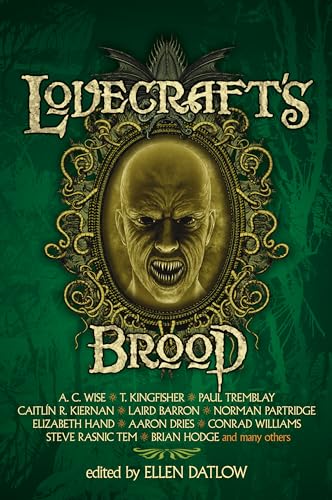
That is not dead which can eternal lie, and that's as true for blogs as anything else. We're back, baby!
We've touched on Lovecraftian stories here and there on this blog, but haven't gone full HPL yet. Well, this is a good time for it: I went to Necronomicon in Providence this month, and Tachyon just released this Datlow-edited reprint anthology. Like many of Datlow's anthologies, it takes an expansive and progressive view of its subject matter; in the foreword, Datlow writes that "most of the stories collected here are infused with cosmic dread rather than the usual, over trappings of H.P. Lovecraft's mythos." No mere pastiche here--these stories take us out to the edges.
Because it's a Datlow anthology, these stories are all high-quality; even the ones that work less well for me are polished and well-written. This also means that there is a lot of material to discuss, so I am breaking this one up into two posts. We'll do half the stories today and the other half within a week or so.
"Once Seen" by Conrad Williams
Synopsis: A photographer traces a gruesome series of suicides to the compelling image of a mysterious woman.
Thoughts: This reminds me a lot of Junji Ito's work: I think it's the combination of modern technology plus an urban setting plus the Tomie-esque way the mystery girl's face infests everything its victims see. You can imagine an Ito panel showing an ordinary scene riddled with faces large and small, their individual beauty belied by the horror of their proliferation.
My problem with the story is that in many ways it's too similar to David Morrell's masterpiece "Orange Is For Anguish, Blue For Insanity," which is one of my all-time favorite horror stories. That's not to say that Morrell has a copyright on ideas like "seeing tiny little faces everywhere in your whole field of vision" or "self-inflicted eye trauma as a means of ameliorating said tiny little faces", but it does mean that (maybe unfairly) I'm going to hold this story to a higher standard.
Thing is, the one area where you could probably improve on Morrell's story--the endearingly goofy explanation behind the horrors--is the one area where Williams fumbles the ball. There are several interesting ideas he introduces--the idea that the girl is actually a helpful warning, and the idea that the real horror might be ultimate self-knowledge--but they didn't cohere for me, even on a rereading.
"Mister Ainsley" by Steve Rasnic Tem
Synopsis: A door-to-door canvasser faints at a recluse's door, to the discomfiture of both parties.
Thoughts: Spoilers follow.
Something I don't associate with SRT is humor. Not that he's humorless; it's just that I don't think of his stories as particularly funny, not in the way that Ligotti or Campbell can be funny. This is a fun, mannered story with a narrator who is distinctly out of place. It isn't a comedic lark, though: There is a gentle sadness here.
Speculating on the degree to which an author's work may or may not be autobiographical always makes me uneasy, like some sort of voyeur; all the more so when it touches on delicate matters. I have heard SRT before say that grief is a major (maybe the major) theme in his work, and that grief has come from personal experiences. One of these would be the passing of his wife, the late (and really, really great) Melanie Tem in 2015. Given this story originally came out in 2017, I must imagine this story was written in the immediate shadow of that grief. Adding to the overlap is the fact that "Mister Ainsley" took his wife's name upon marriage, similar to how Steve Rasnic and Melanie Kubachko took the shared surname "Tem" on marriage (although, I expect, for different reasons than Mister Ainsley).
Okay, so there's grief--what's being done with it, and how does it interact with the surprisingly light-hearted tone of the story? "I can't imagine the world without you" or "I'm lost without you" are commons term of devotion, and if we take it literally, there's an implicit element of Lovecraftian horror: If the beloved is gone, then the world becomes incomprehensible, and its ways and denizens as alien to us as the Plateau of Leng or the sunken city of R'lyeh. What keeps this from being a miserabilist slog is that Tem switches things up--instead of a grieving human experiencing metaphorical horror in a fantastic land, we have a Lovecraftian monster trying to get by on Earth.
Funny, sad, beautiful--and, yes, there's a bit of horror as well.
"Sideways" by Ray Cluley
Synopsis: A post-war test pilot takes a doomed flight on the Arrow, an experimental craft that goes "sideways".
Thoughts: The Fright Stuff!
This is a good story, with fun 1950s test-pilot flavor. Cluley captures the post-war optimism and machismo of his air force milieu well. This would probably make a really fun Delta Green scenario.
There's something effectively 'plausible' about this, in that, of all the various government experiments that lead to eldritch horrors in fiction, this Philadelphia Experiment/"Mrs. Todd's Shortcut" scenario of trying to make the ultimate aircraft is what would do it.
As a matter of anthologizing, I also think that the story placement here is good: The first story certainly has Lovecraftian elements, but you could throw it in any collection of horror stories from the mid-80s on and it would fit in just fine, and the second story is explicitly Lovecraftian in subject matter but not tone. At this point, some readers might be asking, "where are the scary tentacled creepies?", and while that's not what Lovecraft's Brood is about, this is straightforward 'red meat' with, yes, some tentacles and things. It's a good way to keep readers looking for that element of HLP engaged without compromising the expansive mission of this book.
"Empty Shells on a Cold Shore" by Jacob Steven Mohr
Synopsis: Three volunteer sea turtle conservationists discover a strange creature on the shore.
Thoughts: Speaking of scary monsters. . .
A story of weird and terrible beauty that's exactly the length it's meant to be. Mohr gives us quick, sharp sketches of the characters and their dynamics (all of which are realistic), and puts them in the spare, haunted setting of a beach at night.
Then the scary stuff happens and it's, well, scary. Like the story itself, I'm keeping this write-up brief, not so much from fear of spoilers as the fact that there isn't a lot to say about this story. It's straightforward, it's effective, it's well-written.
"The Keep Quiet" by Aaron Dries
Synopsis: A lonely woman has a yearly assignation with a mysterious photographer.
Thoughts: Spoilers-ish.
If Thomas Ligotti rewrote Richard Laymon's erotic thriller In the Dark, you might have something like this.
This is a full story, stuffed with powerful writing and emotions, and a theme that, as a staunch Freud/Lacan fan, love: In what circumstances is the "correct" course following the true path of one's desire if it leads to self-destruction? Dries' twist on the subject, and what gives the story its cosmic horror bona fides, is to go one step bleaker. "[H]ope is the real end that precedes the end," our protagonist states in the first paragraph. In the context of the story, it first seems that our protagonist's hope for connection and for being desired precedes her end through cancer, a cancer the Keep Quiet somehow visits on her. That would be a standard 'death drive' trajectory: The hope is the pleasure/fulfillment of desire, and the end is the risk of death at the end of authentic fulfillment of desire. However, I think Dries is working on a darker dialectic--both the fulfillment of desire and the (bargained-for and accepted) consequence of death come to form the package of "hope" whereas the real end is bleak isolation.
Grim stuff, but don't worry, because next is. . .
"Agent of Chaos" by T. Kingfisher
Synopsis: A playful kitten unravels the fabric of the universe.
Thoughts: Delightful, playful, with a sinister edge. Much of this is a one-joke premise rooted in incongruity (cute kitty first threatens to destroy existence, then unwittingly banishes Azathoth or something like it), but it's a great joke. "The black kitten looked down into the crawling darkness that had existed in the eons before the Big Bang and made an inquiring "Mrrrp?" sound." Adorable.
Two things to mention here: The first is one of my favorite parts of the whole book. Alice, the cat's owner, muses on how she reconciles her Presbyterian faith with her old sailor's belief in the gods of the deep:
"[W]hen you were on a floating husk on the sea, even an enormous metal one. . .you were surrounded by something far deeper and older than anything Christianity could offer. Something cold and alien and vastly uncaring. She suspected that Jesus would have understood. He'd hung out with fishermen in Galilee. They would explained it to Him."
Perfection.
The second is an inverted cosmic horror: Yes, all is meaningless at best. Yes, the follies of man are less than a speck of ichor from an undying Old One. Yes, they'll make cemeteries their cathedrals and our cities will be our tombs. BUT--that applies to ancient, swirling vortices of chaos, too. Just because these things are more powerful and incomprehensible than us doesn't mean that they aren't equally subject to the whims of uncaring fate. And so, the plans of the unmaker of the universe are spoiled by a cat that doesn't know what it's doing.
Hell, Cthulhu rose in the 1920s only to scare a couple sailors to death and then get KTFO'd by a yacht. Nonsense cuts both ways. There is no Big Other pulling the strings, not even a malign one. It's funny, but in a sense even more profoundly unsettling.
"The Beholder’s Share" by Caitlín R. Kiernan
Synopsis: A man recounts the hideous and bizarre consequences of his girlfriend's purchase of some esoteric books.
Thoughts: Kiernan's piece is one of the most explicitly Lovecraftian stories in here; in fact, it works as a sort-of-sequel to "The Haunter in the Dark," focusing as it does on the Starry Wisdom cult of Providence and their fascination with the Shining Trapezohedron.
But there are probably one or two hundred good continuations or sequels of HPL stories already, and thousands more bad ones (some horror writer, I don't remember who, once said that everyone has a good Lovecraft story in them, but the problem is they never stop at one); what makes Kiernan's story transcendent aren't the Lovecraft influences but the Charles Fort influences.
Kiernan is, of course, well-versed in Fort, and explicitly name-checks him towards the end of the tale. More importantly, the writing style is similar to Fort's: Dancing from "damned" data point to data point, and cutting from primary source citations of anomalies to gnomic proclamations, or switching back to reference a line of thought from several pages ago. One great example sees our narrator muse on what, if any, meaning the dates connected to certain important events have for the mystery.
"The painting is dated 1899. 1898. 1948. 1853. 1899. 1912. 1951. Numerology is for idiots."
Like Fort's work, this is a work animated by a dark wit, one which does not leaven the horror so much as enhance it, and leave you with an aftertaste of disquietude.
"Backbite" by Norman Partridge
Synopsis: Two brothers in the Great Depression turn to armed robbery, but there are darker forces at play than .38s and shotguns.
Thoughts: It's interesting to contrast the early Partridge of "Guignoir" to the fully-realized Partridge of "Backbite," and a joy to see the latter pay off the former's early promise. Partridge's all-American pulp stories are exhilarating, capturing the energy and fun of his inspirations while adding his own professional polish.
There's one moment in here where a severed hand skitters across the floor, with the tattered remnants of its undead owner close behind. We've seen these movies before, and many writers (including most of us, at one point or another) have tried in prose to recreate the cool horror film effects we love, only to wind up derivative at best. Partridge writes with such energy and verve that he never falls into this trap; it all feels fresh, even while it also triggers a fond sense of familiarity.
Something else Partridge does well, in stories like this or the superlative "Lesser Demons" (one of my all-time favorite horror stories of the 21st century so far) is how he uses that other all-American element, the firearm. A problem that comes up when adapting the Cthulhu Mythos et al. for gaming or more action-oriented stories is that machine-gunning eldritch horrors misses the point, but you have to have some sort of interactivity to make it fun. Partridge threads that needle with double-ought buckshot.
"Eat the Wyrm" by Elisabeth Hand
Synopsis: A Greenlander produces a very rare, very odd brand of booze.
Thoughts: It's a neat vignette, with a striking final image, but this isn't more than the sum of its parts.
However, the parts are very cool and very good. I like the arctic setting, which has a used-future cyberpunk feel to it, even if it's the present. Ultimately, it's like a quick shot of something strong that gets the job done.


Comments
Post a Comment