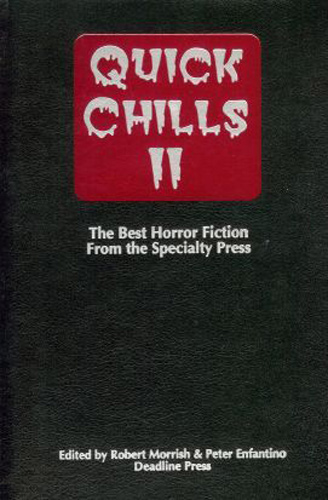
If You Are The Big Tree We Are The Small Press: Quick Chills II: The Best Horror Fiction from the Specialty Press (ed. Morrish & Enfantino)
I love the old small press magazines from the 1980s and 1990s--Cemetery Dance, Deathrealm, The Horror Show, and so on. Sure, the Internet has made it even easier for 'zines to get made and distributed--there's no shortage of short horror fiction magazines and podcasts online--but, like most analog media, there's a magic to the old school magazines. A lot of it is in the imperfections, which, like the shot-on-video horror movies that were proliferating in the same period, add either goofy charm on lo-fi creepiness. In some cases, as with this cover for Deathrealm #27, it's both (warning before you click--it's SFW and not at all graphic, but it is going to be alarming when it pops up on your screen). This, by the way, so upset the Canadians customs authorities that they banned the issue, which is a bit rich, considering this is the country that gave us David Cronenberg. Maybe they should have added a note that the baby spoke French and it would've been okay.
Anyway, this was Volume 2 of 2 (Morrish and Enfantino intended it to be a biannual series, but alas that never happened) of a series that sought to supplement Karl Edward Wagner's Year's Best Horror Stories and Ellen Datlow and Terri Windling's Year's Best Fantasy and Horror by focusing on small-press magazines.
I haven't been able to track down Volume 1 yet, but among the delights Volume 2 has is an "Honorable Mentions" section. I skimmed that when I was done, and one of the stories I saw that I'd read before was "Snow Cancellations" by Donald Burleson.
This story and I go wayyyyyy back to my grade-school days as a baby horror fan, and I thought it would be fun to take it and compare each story in here to that tale.
It unfortunately isn't available anywhere online (even though it's an absolute slam-dunk for a Tales to Terrify or Pseudopod episode), but here's someone else's commentary on it. It's an entry in that seemingly paradoxical sub-genre, apocalyptic quiet horror: Two boys, stuck at home during a snow day, pass the time by chatting on the phone and listening to the radio announce the snow cancellations. Cozy enough, except the 'cancelled' institutions seem to be disappearing from reality, and the things that are being cancelled go from schools to hospitals to apartment buildings. . . you get the idea. It is simple and effective and the best possible version of itself, so why not take a page from Joe Lansdale's "The Pit" or Dick Laymon's "The Champion," and force it into unwilling combat against the best of the best from the early '90s horror small press?
Is This a Horror Story? by Scott Edelman
Synopsis: A writer and his wife discover a packet of disturbing photos.
Is It Better Than "Snow Cancellations?" A close call; both leave you with a lingering sense of unease, but I think Burleson's is "earned" a little more, because a lot of the unease in Edelman's comes from hiding the ball.
Thoughts: A provocative one to start off with; Edelman writes that he wrote this story out of dissatisfaction with the staleness of classic horror tropes. This is also a formal experiment; a deliberately ambiguous tale that presents itself as "real" (the narrator, presumably Edelman, is himself a horror writer), but Edelman writes that he doesn't know whether it's fiction or non-fiction.
Two levels of ambiguity, then. The first, the content of the story itself, in which a photograph of a child that in other contexts would be unremarkable becomes, through the power of juxtaposition, something still not quite criminal but indicates "an interest in children." Is this a horror story? That is, has a crime occurred (or almost occurred), or is this just a collection of evidence that's circumstantially suspicious but not in itself probative?
The second level is, is this, the anecdote itself, a horror story (a made-up tale to frighten and disturb for entertainment), or is it real? And, if the latter, does that make it any less of a horror story?
It's interesting, and unsettling, but I don't feel that it has the weight it should. It winds up feeling like analytic philosophy--an interesting game with words and logic about what is and what isn't, but not tied to a real-world argument in any way. I think I can guess at Edelman's argument ("Dracula is old-hat, real horror is real life"), and it's a fine one, but this was already a common argument by 1991, as New Horror reached its peak. Edelman sets up some intriguing questions, but then ends rather than diving into analyze.
The Two-Headed Man by Nancy A. Collins
Synopsis: A lonely waitress meets a strange pair of circus performers.
Is It Better Than "Snow Cancellations?" Another close call, although I give this one the edge because I think Collins' writing is stronger.
Thoughts: Good, although it's not exactly horror; it's more like weird erotica. And it does succeed in that regard, I think. The problem, is that once you buy into the idea that she's gonna menage a trois with Gary and Carl, the story plays out like "normal." Yes, it's an unusual and grotesque situation (although note that Collins never treats her 'freaks' with disrespect), but there's no further swerve. Of course, some (including Playboy, who turned this down) might say that Collins has already swerved quite enough by that point.
Cold Touch by Brad J. Boucher
Synopsis: A thrill-seeker and porn addict dives into the world of necrophilia.
Is It Better Than "Snow Cancellations?" Nope, which goes to show that a creepy, quiet piece of dread can be better than all the sick sex and violence in the world (not that there's anything wrong with sick sex and violence, as we'll see with the next story). Burleson was robbed!
Thoughts: Our first proper horror story, except unfortunately it sucks. The "guy looking for harder and harder core pornography gets more than he bargained for" is a well-worn trope, with Jack Ketchum's "Mail Order" serving as the baseline for a competent execution of the theme. There are some good versions (off the top of my head, Ramsey Campbell's "Cold Print" and J.F. Gonzalez's "Addict" come to mind); this is not one of them. All of the character build-up is telling, not showing; the showing, it seems, has been reserved for graphic descriptions of necrophilia. The thing is, something like necrophilia has a serious case of diminishing marginal returns; the first instance is shocking sometimes, but after that, it's as compelling as skimming Cannibal Corpse liner notes (except without good artwork).
The very end flirts with being interesting, with a twist reminiscent of Edward Lee's not-yet-written "ICU", but it's not enough.
Hot Orgy of the Caged Virgins by Elizabeth Massie
Synopsis: A group of bored young country-dwellers can't make it to New York for a porno, so they make their own instead.
Is It Better Than "Snow Cancellations?" Dude, it's almost as good as "Night They Missed The Horror Show." Yeah, it's better than "Snow Cancellations."
Thoughts: Oh. Oh dear. Well, I wished for a horror story, and that's what I got. . .
You don't write a title like that without bringing some firepower behind it (see also: David Schow's "Blood Rape of the Lust Ghouls"), and here Massie gives us a super-sick take on the "let's put on a show in the barn!" plot. And by super-sick, I mean this plays out along similar lines as Joe Lansdale's splat-classic "Night They Missed The Horror Show." We have bored, casually cruel rural teens whose adventures get progressively worse and worse until you're muttering "oh, NO" every second paragraph.
Something I really enjoy here is the way the rural/urban divide plays out. Our narrator begins by assuring us that out in the country they know just as much as in NYC, and set up the notion of big-city sophistication and sexual degeneration; in fact, the sickness of the local production of "Hot Orgy of the Caged Virgins" is based on imagining what they get up to in the city. But, of course, the joke (such as it is) is that our characters know just as much about sexual perversion as they do in New York; indeed, Massie implies, through the minor references to child beating and sexual abuse early on, that the country is a far sicker place than the city.
Woman's Little Wound by Nancy Holder
Synopsis: A man is convinced his loving wife is a misandryist who wants to kill him.
Is It Better Than "Snow Cancellations?" The writing's a bit stronger overall, and I like the satirical edge. I'd say it's a coin flip: There's a lot of stories about violent sexual hang-ups, but there's also a lot of stories about endless, apocalyptic snowfall.
Thoughts: Yeah, it's what you think it is. Enfantino and Morrish note, by the way, that they front-loaded the stories with sexual themes. Given that this is small-press horror from the early '90s, that winds up being about 30% of the stories here. I know, only 30%?!
Anyway, the story: Conceptually, I like the idea that this guy is living in the private hell he's created from his own misogyny; I imagine this is a send-up of all those men who go about blaming feminism for their own problems. However, the story itself is so unpleasant both emotionally and viscerally that I don't see myself rereading it anytime soon. That's not a criticism--I think that's what Holder wanted to accomplish, and she did.
Memories by Yvonne Navarro
Synopsis: A minister is blackmailed over the horrific murder of a young woman.
Is It Better Than "Snow Cancellations?" Nope. Some of the ideas and execution are interesting, and Navarro sticks the landing after a stumble, but this is too jerky and uneven, whereas "Snow Cancellations" progresses at a steady, even pace.
Thoughts: A corrupt preacher doing a sex murder? Yup, it's early '90s New Horror! Except, well, did he?
It's fun in horror, or any genre fiction, when characters in a conventional set-up take a reasonable, sensible route instead of what you'd expect. In these cases, normalcy can be unexpected. My favorite example is in the first act of Insidious, where the family explains away the weird stuff happening in their new home until the point the threat becomes undeniable--at which point, they do the rational thing and move (See also: The gag at the very end of Poltergeist). It doesn't help, of course, but that's not the point.
There's something Scooby-Doo about the final confrontation, right down to a "why I did it" speech that undermines the tenuous ground the story's been built on. However, Navarro gives one final twist of the New Horror knife at the end, reminiscent of Ray Bradbury's classic "A Touch of Petulance."
The War Inside by Mark Budz
Synopsis: A man visits a Detroit brothel, the Old Nam, for a taste of what the war was really like. He gets more than he could have imagined.
Is It Better Than "Snow Cancellations?" No. There's a lot to this piece that's intelligent, provocative, and depressing, and the writing is good. I prefer the Burleson story, however, because it's more consistent and, although it has more limited ambitions, it successfully fulfills them.
Thoughts: You can't spell PTSD without STD! That, in a glib nutshell, is the concept of this piece, which at its best points reminds me a lot of Harlan Ellison. Like Ellison's work, "The War Inside" uses fantasy to both dramatize the power and the damage of sex and relationships, and to provide political commentary.
The problem I have with the story is the question of "why" this is happening. Budz suggests that the Vietnamese women at the brothel are getting some sort of revenge on Americans by passing on their trauma, but I don't quite buy it. If anyone's deserving of this sort of revenge, it's the narrator's repellent friend Rick, but Rick seems to thrive on all of this. More interesting is the idea of the narrator's guilty conscience for never having served in the Vietnam War driving him to experience what it was "really like", but I don't feel that gets fleshed out, either. We're left with a story that has powerful language and compelling ideas that's trying to say something politically important, but isn't sure what it is.
Darkling by Robert E. Cook
Synopsis: A young man has an uncanny knack for survival, even as all around him perish.
Is It Better Than "Snow Cancellations?" There's a version of this that is, but it's not in the story as written here. That version, by the way, is called Deathdream and for sheer grimness of "Monkey's Paw" variants, it outdoes Pet Sematary. The same issue I have with Navarro's story is the issue I have here--there's too much jerky stopping and starting, but it's much worse here because of the moves through different moods and tones (I'll describe more below).
The very best moments of this story, though, are better than Burleson's tale. It's just that I prefer consistent quality to brilliant peaks and 'meh' troughs.
Thoughts: The second of the two 'Nam stories It sort of reminds me of Douglas Clegg's "The Rendering Man", which showed up in Cemetery Dance a few years after this (and would surely have appeared in Quick Chills III, if there had been one).
Both have three act structures, both of those structures are "important childhood event with some strange, lynchpin that occurs during violent historical moment, and denouement with a final bit of surprising violence." Both are also enjoyable stories with strong horrific finishes, although Clegg's is better (which is intended as a compliment to Clegg, not an insult to Cook).
The best portion here is the middle, where Cook moves from telling to showing, and includes odd little details that are so strange they paradoxically give the story some verisimilitude, because they're too weird to make up otherwise; the best is our narrator, back at base after an ambush, obsessively chewing his way through a case of gum for no clear reason.
The very ending grabs you by the throat; even though it probably isn't the first time you've encountered the concept, it's stunning, like a nasty comic-book splash panel.
People Who Love Life by Douglas Clegg
Synopsis: An outcast in a small village just wants to die, but her brother-in-law won't let her.
Is It Better Than "Snow Cancellations?" Yes. The story suffers a little from trying to hide the ball past when I think we're supposed to figure it out. However, if Burleson's story is an example of taking a straightforward premise and playing it to its obvious conclusion, Clegg's is taking a straightforward premise and taking it to some unexpected places.
Thoughts: Speak of the devil!
Is this really the first appearance of Douglas Clegg on this blog? If so, that's an oversight on my part. Clegg's The Nightmare Chronicles was, when I read it in my post-college binge of every Leisure Books horror title I could get my hands on, I'd missed from the late 90s through the mid-2000s.
I'd pitch this as "Shirley Jackson's The Monkey's Paw." It has the horrific inversion of the fantastic (miraculous healing that's anything but) from the latter, but it has the small-town atmosphere and choked, toxic family and social relationships of the former, and it delivers us to a heartbreaking ending.
This is all very good as it is, but then, at the very end, Clegg does what he so often does, and rams the knife in one more time for an ending I think made me actually, audibly gasp.
Last Rodeo on the Circuit by Bentley Little
Synopsis: Two pairs of travelers discover a very strange rodeo in Sheep Springs, AZ.
Is It Better Than "Snow Cancellations?" Yes! The one difference is the ending--both end on a note of doom that's inevitable but hasn't actually happened yet, but Burleson's is scarier. Little's could have been, but it isn't quite as sick as could be.
Thoughts: I often think of Bentley Little as a sort of weird, warped Richard Laymon. Like Laymon, Little has a clean, straightforward style which he uses for sick mayhem. The difference is that Laymon's material generally follows well-trod paths, whereas truly anything can happen in a Little story.
In a way, the Hills Have Eyes style set-up is like something Laymon could have done (and Laymon's story "The Champion" deals with similar material). But then you read the sentence, "It was then that she noticed the four dwarves getting out of the truck," and you know you're in Littleland.
I'm not convinced about the length--it should have been either longer and shown more of the rodeo's horrors, or else shorter and avoided the rehash feeling we get in the second half--but this is good sick fun.
Guignoir by Norman Partridge
Synopsis: Ed Gein-ish serial killer Hank Caul haunted the town of Fiddler. When a family of carnival hucksters show up with Hank Caul's "Death Car," sparks fly.
Is It Better Than "Snow Cancellations?" It's more important. This is the sort of story that made Partridge a big deal in the early '90s, and helped launch (to everyone's benefit) one of the most distinctive voices in modern American horror fiction. "Snow Cancellations" might be more successful at fulfilling its more limited ambitions, but "Guignoir" is really swinging for the fences, and if it isn't batting a thousand, it's close. I realize this is kind of the opposite of why I ranked "Snow Cancellations" over "The War Inside." Ah well.
Thoughts: I'll keep this brief. The reason that this story, and Partridge's work in general, works when so much other horror that combines '50s horror/drive-in/kitsch culture with more hardcore content (*cough* House of 1000 Corpses *cough*) is that Partridge has something more to say other than "Geez I like all this old stuff and adding blood to it is cool!" In this case, Partridge's examination of the concepts of being the con man vs. being the mark in American culture (and specifically the kitsch culture of the carnival, the tall-tale, the urban legend), and the role that myth plays in horror and culture, is what makes this more than just a bloody, slightly overstuffed horror/crime hybrid. Essential reading.
The Sharps and Flats Guarantee by C. S. Fuqua
Synopsis: A struggling musician acquires a guitar owned by bluesman Robert Johnson, who supposedly made a deal with the devil.
Is It Better Than "Snow Cancellations?" If everything were as good as the last paragraph, yes. However, it isn't. The key difference: Burleson's story slowly but steadily accumulates menace, the same way an incessant snowfall quietly but inexorably builds up around you. Fuqua's story, by contrast, has a decent enough beginning--the small shop offering a ridiculous low price on a rare item isn't original but it's a fair enough starting point--and then breaks down into a meandering through a failed music career before finally returning to horror.
Thoughts: The story of Robert Johnson is cool, but it does feel done to death by this point. So, the best version of this story (guy makes Faustian bargain, guy reaps rewards, guy attempts to escape paying the price and almost certainly fails in grisly fashion) would still feel like a rehash.
This isn't the best version of the story. Most of it is some musician who may or may not be good (I get that communicating musical talent over the page is hard to do, but if you're writing a story about a musician and he's supposedly very good, you need to try).
When the horror actually shows up at the end, it's cool (and makes one think that Sharps and Flats should open a location in Greystone Bay), but there's no feeling of either EC Comics justice or else cruel cosmic injustice from what's happened.
The Rabbit by Jack Pavey
Synopsis: Two buddies try to fix things after their dog shows up with the tyrannical neighbor's rabbit in its mouth.
Is It Better Than "Snow Cancellations?" Another coin flip. Before rereading this one, I'd have given it to Burleson by a nose (a small, cute little bunny nose), but I forgot how strong the writing in this is, and that pushes it to a tie.
Thoughts: I ran into this one in The Best of Cemetery Dance way back when, and I enjoyed it. This is a variant on the "Resurrected Rabbit" urban legend (I've also heard it called "Bunny Laundering"), although with a sick twist.
Familiarity breeds contempt and, unlike "Metastasis" below (also in The Best of Cemetery Dance), it wasn't so good a story that I was looking forward to rereading it. I was wrong. Pavey's writing is the star here; it's straightforward and funny and feels like an ordinary guy talking to you over a beer.
The other thing that makes this a winner is the bleak opening, which contrasts with the above. It sells the otherwise slight horror content here as the trauma it would be in real life and having it crack the soul of our likable (and blameless, really) narrator. The way he flees into vagrancy after it all unfolds reminds me of the haunted souls in Dennis Etchison's stories ("Sitting in the Corner, Whimpering Quietly" in particular), living ghosts in a city of human madness.
A Silent Scream by Ann K. Taylor
Synopsis: Cathy's emotional problems already strained her marriage, but things reach a terrifying new stage when her husband finds her fully cocooned in bandages.
Especially when the doctors discover the bandages are fusing to her skin. . .
Is It Better Than "Snow Cancellations?" It isn't, but it could be. The ideas and images are great; the problem is managing the necessary time lapse between the different stages of Cathy's metamorphosis. We wind up lurching from point to point, which kills a lot of immersion.
Thoughts: I was going to read this one real quick before bed a couple nights ago. I've mentioned this before, but I often read anthologies out of order and start with a couple quick stories first. I realize this may dismay the editors and writers who painstakingly arranged their story order. . .but, hey, I'm reading your book! Just be happy about that!
Anyway, even though I can usually read and watch horror right before bed without any problems, the one-two punch of Edelman and Massie's stories had me feeling uneasy. I wish I had read this one, though, because I think I would have been more susceptible to the terrifying elements of this story than I was reading it in daylight. The images and ideas are scary; I loved them.
The problem is that there's a version of this story with much more emotional impact. We never really experience what there is about Cathy that makes her and her marriage matter to us, or understand how her preceding mental health crises make this final abomination seem inevitable. It's good, but it could be great.
Misfits by Stephen Mark Rainey
Synopsis: A heavily-armed group of survivors defend a bar against extradimensional invaders.
Is It Better Than "Snow Cancellations?" Young me would have thought so, but young me, as we've frequently seen on this blog, was wrong. It's cool to read and imagine all the violence, but as "Nightcrawlers" demonstrates, you can do all that and still have emotional heft.
Thoughts: Rainey was of course a big figure in the horror small press world of the time, thanks to his work with Deathrealm. Here, he turns in a tale of his own.
Look, this isn't boring. There's cool monsters and a TON of guns, and people get mutilated and slaughtered and monsters get exterminated. And there's nothing wrong with remaking Rio Bravo as a horror story (George Romero and John Carpenter have been doing that for much of their careers and it's worked well for them). But it's not new.
This is that same issue I've mentioned where a story that isn't bad seems underwhelming based on the company it keeps. We have stories like Edelman's and Massie's and Clegg's and Braunbeck's, and then there's this.
There are small, cool touches; There's a nasty bit with a sexual element that doesn't seem sexually-motivated, if that makes sense--it reminds me of the that reminds me a little of the sexually-based monster from David Schow's masterpiece "Not From Around Here." There's also an extremely intriguing part where the monsters claim to love us, which suggests they may be angels, but Rainey does nothing with this. Maybe it's intended for a larger work, in which case, fine, but you can't toss a cool idea like that around without
It reminds me of stuff I've written--enthusiastic, and having a good time taking the elements from the books and movies the writer loves, but not necessarily justifying its existence. Well, nothing needs to justify its existence; I bet Rainey had a blast writing it, and I'm interested enough that I'd read more in this world.
To His Children in Darkness by Gary A. Braunbeck
Synopsis: A disabled teacher and a bitter ex-sheriff
Is It Better Than "Snow Cancellations?" Oh, yeah. Most definitely.
Thoughts: An eye-watering bit of graphic violence to a resident of Cedar Hill that makes everyone feel super-depressed? Yup, it's the start of a Gary Braunbeck story!
By the early '90s, Braunbeck was regularly bombarding the world with emotionally-resonant, well-crafted horror stories, and he's kept it up to this day (he also, as we've seen, writes a mean Joe Lansdale pastiche).
Something Braunbeck is very good (and he demonstrates it here) is using moments of visceral horror to underline emotional beats in a story. There's a lot that's gross in this story; Braunbeck even leans into it a little at one point by beginning a section with "No one ever figured out the semen." This is, I think, as close to a joke as we get here.
But it's all in the service of a dark, brooding tale that brims with emotional power even as the "main" plot is an extravagant horror-fantasy. At no point in the story could I really predict what would happen next, and I had a very personally moving moment while reading this.
I was enjoying the first stirrings of summer weather outside reading this story, and I felt complete kinship with my young self, back in the summer of 2002 or 2003, sitting outside and reading Gary Braunbeck's "Haceldama" in, you guessed it, The Best of Cemetery Dance, and the joy and the wonder and the terror of being led into these worlds. If trauma is an unpleasant experience or a physical/emotional state from the past replicating itself in the present, then this was. . . not even nostalgia, because nostalgia implies some yearning, but here there was no sense of loss. I'm tied to my past self--somewhere, back there, in 2002, he's lying around sipping a Diet Coke and reading Gary Braunbeck, and here, in 2026, I'm lying around sipping a beer and reading Gary Braunbeck, and we're connected.
Perfection.
The Shaft by David J. Schow
Synopsis: A coke dealer finds himself spending a Chicago winter in a crummy apartment complex with something in the walls.
Is It Better Than "Snow Cancellations?" Another coin flip, this time between two stories that deal with huge amounts of snow. "Snow Cancellations" is a better horror story, but this invites more rereads.
Thoughts: Some writers work well binge-read; others don't. Schow is, like Robert Aickman (there's a comparison you don't see every day!), a writer I find better read in binges because it can take a bit to get into his groove.
Even by Schow's standards, this is a particularly over-stuffed one; the story itself feels like it's done a couple lines of blow and is rambling away at high energy.
The problems with the over-descriptive, manic style that you see in some splatterpunk is that it slows you down when you're trying to zip along. Both Schow and John Skipp run into this problem sometimes; by all rights Joe Lansdale should run into that problem too but he doesn't because, well, he's Joe Effin' Lansdale.
That problem is biggest at the beginning; at that point, the reader is orienting themselves in the story and figuring out where we are and what the rules are. So all the figurative language and over-the-top metaphor makes it tricky to dive in. Once we're there, though, it's an entertaining world to spend time in, with plenty of funny and sick and outrageous Schow touches; it feels more like a crime story with horror elements tacked on, but it is a fun crime story.
Foreign Bodies by Jeffrey Thomas
Synopsis: A man faces a crisis of conscience when confronted with a wounded alien at his front door.
Is It Better Than "Snow Cancellations?" Genuine, honest coinflip time here: Thomas is trying to say something, and it's a fun point, but I think the prose is mostly a bit turgid.
Thoughts: An interesting and provocative one, that takes risks in its investigation of racial prejudice. Some might say it takes too many risks: "Dark-skinned immigrants actually are space aliens" is a reveal that's a hard sell for me in the absolute best circumstances; as it happens, I'm concurrently reading Elizabeth Massie's Welcome Back to the Night, in which a group of white supremacists believe non-whites actually are an alien species, so I am particularly skeptical.
But, really, this is "Nothing in the Dark" by way of the live-fire test scene in Men in Black (where the right answer is that the two obviously 'alien' targets are hideous but harmless, whereas the 'harmless' human is not what she seems). It's also the story of a man who doesn't think of himself as racist, and actively tries to fight his own prejudiced tendencies, but nonetheless finds himself doing racist paintings for a work buddy and otherwise feels "the tug of prejudice quite strongly. . ." But Seagrave isn't a bad guy, either; he does bad things, and has bad attitudes, but he also has good ones. They're just not all of a piece.
This all comes to a head with one of the funniest, and sharpest, bits of social commentary I've stumbled upon in speculative fiction in some time: Seagrave is agonizing over whether the injured alien outside is a threat or is seeking help, and decides to embrace his liberal impulses. "But what Seagrave never would have admitted to himself at this self-congratulatory moment was that if the stranger outside had proven to be a wounded black man, he would have phoned the police without hesitation. Whatever the circumstances were. And kept the chain bolted until they got there."
One might say that the moral of the story is that the violent outcome Seagrave's attempts to "do the right thing" and help the injured alien are pushing the line that Don the racist was right. But, really, Seagrave brought this down on all of them by being more racist even than Don in his depiction of a Libyan terrorist as his dark-skinned coworkers. . . a depiction they wind up interpreting, reasonably enough, as a threat.
The Deprogrammer by Robert M. Price
Synopsis: A deprogrammer gets hired to extract a girl from the Starry Wisdom cult.
Is It Better Than "Snow Cancellations?" Yup. More than anything else, it wins on re-readability. "Snow Cancellations" is a creepy story and it stands up just fine whenever you re-read it, but, kind of like "The Shaft," there's more fun to be had along the way in Price's tale.
Thoughts: So much fun! "What if a deprogrammer tangled with the Cthulhu Mythos" is a terrific premise, and the backdrop of the American anti-cult movement and the deprogramming industry is entertaining. Price's jaded deprogrammer Brigham (and even that last name feels like a particular choice, considering the best known Brigham in America) is a good narrator; cynical without being overly hardboiled.
The fact that the initial deprogramming goes very, very badly is no surprise, but Price doesn't end there. Instead, Price looks into a question that has to nag at anyone who reads about all of those Cthulhu cults and similar sects: "What, exactly, are they getting out of all this." Price's answer is creepy, but has an otherworldly beauty to it.
By the way--this story is available to read free on Price's own website.
Nine by Dan Perez
Synopsis: A woman drives her battered sports car in pursuit of a demon.
Is It Better Than "Snow Cancellations?" It's difficult to compare because the two stories have very different plans of attack. Perez is bringing a guerilla raid that hits and vanishes, leaving you dazed and bleeding, while Burleson lays a long, grinding siege against you. I give Perez's story the edge because, as the editors note in their introduction, there are lots of ways to go wrong with super-short stories, but Perez nails it.
Thoughts: There's a great tweet that begins with comparing the glows of light people with astigmatism see around streetlights and headlights with the auras of angels, and ends with accelerating into another driver: "I am the Sword of God."
And...that's what this story is, but played straight. What makes this story stand out are the details that Perez gives and then refuses to respond to them. Specifically, the fact that our protagonist is driving a brand-new Porsche (by now, completely smashed up), and that her dress began the day white but is now stained with blood. Whatever madness or possession is at work in the woman, it seems to have happened very quickly and recently. The mystery there, combined with the visceral action and the sick-joke punchline, make this one of my favorites in the book.
Dark Values by Kiel Stuart
Synopsis: A snobbish gallery owner makes the mistake of snubbing a strange artist.
Is It Better Than "Snow Cancellations?" No. There's a zip to Stuart's writing, for sure, but it doesn't go many interesting places.
Thoughts: We last encountered Kiel Stuart with her creepy story "He Whistles Far And Wee," which I continue to think is one of the best Greystone Bay stories that didn't appear in one of those anthologies.
This is lighter, but also less original. "Arrogant jerk gets comeuppance" is a great premise for hundreds if not thousands of fantasy and horror stories over the centuries (Basil Copper's "Camera Obscura" comes to mind as the best of the bunch), but it means that, by the end of the first couple paragraphs, we can tell where this is going.
That's not a problem--anyone who loves slasher movies or Hallmark-style Christmas movies (which are, I sincerely believe, slasher movies for people who want nothing to do with slasher movies--much of the pleasure in them comes from execution of the same blueprint) will tell you that. But in those formulaic stories, it's what happens along the way to seeing the blueprint fulfilled that's fun. Here, Stuart just gives us some artsy-fartsy types babbling buzzwords about hypocritically-political conceptual art. And that stuff can be fun, but too often, as here, that comes off as sort of anti-intellectual. Much funnier is the jaded international art critic admiring the driftwood and rope in an art installation on its own merits.
As for the ending--I'm all for people being sucked into things, and it worked well in "Far and Wee." But all "trapped in a painting" makes me think of is, "wow, I haven't watched Death Bed: The Bed That Eats" in years! And. . . that's not a great place for a story to be.
Drinking Buddies by Wayne Allen Sallee
Synopsis: Two serial killers talk shop at a Chicago dive bar.
Is It Better Than "Snow Cancellations?" In terms of prose, absolutely. I love Sallee's stuff. But in terms of content, this has all the taste of a shot of Malört without the charm.
Thoughts: You can't spell "Always happy to see in a table of contents" without W-A-S, which spells WAYNE ALLEN SALLEE, baby!
However, like the last WAS story we covered in here ("Fiends by Torchlight"), this is a lesser Sallee story (I'm still in shock that there is such a thing). The prose is great, and the weird beginning with almost a Crypt-Keeper like bum figure getting pissed on is a neat introduction and repulsive in the right ways.
About that intro--the preface to this piece notes that it was being expanded into a novel, which I don't believe ever came to fruition (and in all honesty I'm not totally convinced we missed out--but we'll get to that). There's also throwaway references to other Sallee story titles and the events of some stories themselves (Dennis Cassady and the L Train murders from Sallee's famous "Rail Rider" trilogy of stories come up a couple times, in fact); I wonder whether the beleaguered "Spasm" was going to be some sort of narrator figure.
The story itself doesn't work because serial killers. . .don't really interact like that in real life, do they? Maybe they get asked for their thoughts on other cases, but when they're, uh, in the wild, it's not like they're vampires or werewolves (this was always kind of my beef with Dexter as well). Serial homicide is (happily) aberrant and rare (the FBI's estimate of 25-50 active American serial killers at any given time is incredibly small given the United States population, although when you're alone at night that number still seems very high), and it's profoundly idiosyncratic. They're not supervillains. It's all so at odds with the gritty realism up to this point that I wind up wanting to send this drink back.
Metastasis by David B. Silva
Synopsis: The impacts of chemical pollution, both at the small and large scales.
Is It Better Than "Snow Cancellations?" Yes. Any Silva story is usually going to be one of the strongest in any collection, and that's true here as well. In a way, Silva beats Burleson at his own game (not that either of them knew they were in competition)--both stories deal with inexorable doom from nature gone awry, but Burleson's story doesn't have any larger meaning (it's just an entertaining weird tale), while Silva's
Thoughts: Another winner from The Best of Cemetery Dance, in which Silva proves he's just as good a writer of horror stories as an editor and publisher of them (Silva published the excellent The Horror Show). As with "The Calling," there's a lot of focus here on the granular pain and indignity of cancer. However, where "The Calling" emphasizes the malignity and monstrosity of cancer itself, "Metastasis" looks at the collateral damage chemical and radiation therapies wreak, and questions when the cure is worse than the disease. There's an effective eco-horror subplot as well, which pulls off a feeling of creeping dread without having to try.
Clearance to Land by Adam-Troy Castro
Synopsis: A vicious terrorist hijacks an airliner for a very unusual prisoner exchange.
Is It Better Than "Snow Cancellations"? Yeah. It's better than 90% of everything I've read this year.
Thoughts: Castro's been in my good books since I read his exemplary "Family Album" in John Pelan's first Darkside anthology (not that Castro was in my bad books before that). Like that story, this is a tale of enormous power and darkness with an emotional heart.
It's not perfect, the same way "Family Album" is--there's a part about 3/4 through where the story has an action sequence and we have to start tracking things on a more realistic level. Still, Castro nails the landing with a mixture of horror and hope.
Recommended in the strongest possible terms.
The Place Where All Things Go to Die by Susan M. Watkins
Synopsis: A child discovers a junkyard where everything everyone has ever lost or thrown away goes.
Is It Better Than "Snow Cancellations"? It should be; it's going to some darker, more adult and emotional places, and the prose is about the same quality. However, it gets bogged down in questions of its own mechanics and logic.
Thoughts: That's a cheery title to end on! I've read some of Watkins' other work in The Horror Show and enjoyed it, and indeed this tale appeared in The Horror Show and got reprinted in The Definitive Best of the Horror Show (which we are absolutely going to cover here sometime).
This story is a let-down because there's too much going on here--the fairy tale rules about what you can and can't take out of the junkyard are a good idea, but I felt they introduced a level of complexity and "tracking" that takes away from the emotional heart.
Similarly, the more generic horror elements--moldering monsters in the dark--weren't a compelling threat. The problem is that the story would work better as a dark fantasy without explicit horror elements and it would end with our protagonist discovering "herself" in the discards heap of her second husband's section of the junkyard. That moment of emotional pain in literalized metaphor is something that speculative fiction can give in ways other types of writing can't; it's precious and pure and it's the soul of the story.


Comments
Post a Comment