Night/Day (ed. Ellen Datlow) Part II: Day
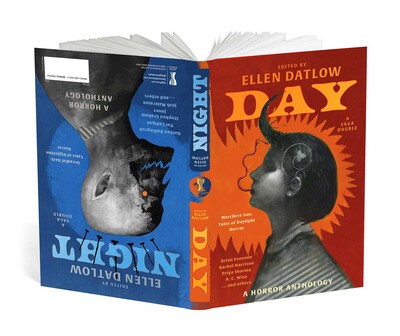
I was excited for Day, since the concept--horror set in and/or about the day--is a challenging and creative one. There are three categories of story here:
- Ones about the day and the daylight as such as the setting for horror (this is what I expected going in).
- Ones about light as such, but not necessarily day.
- Ones that seem to be using daytime and taking place during the day as a way to juxtapose horrific content with the quotidian.
The Bright Day by Priya Sharma
Synopsis: The UK of the future is a sun-scorched wasteland full of cults and scavengers.
How Diurnal Is It? Type 1. This story has to take place in the daytime, and it was the obvious choice as opener for the Day section. Light, brightness, and daytime are all the subjects of horror, possibly even on a supernatural level.
Thoughts: This is a grim, Mad Max as horror story tale in the vein of The Road. The first section is good and tense, and cinematic without feeling derivative of other post-apocalypses. The middle, while more predictable, is grueling and mean. I liked it, but there is a slight sense of killing time while waiting to see how it will all turn out. And then--Sharma yadda-yaddas the best part. Some of this is thwarted catharsis: After spending much of the story seeing our protagonists tortured by bandits and the sun, it would be nice to see them get some of their own back. But, beyond my own insatiable bloodlust, there's the question of what Mel's solar apotheosis entails. Is it just the rage of someone pushed to the edge who finds they can endure what they thought they couldn't, or is the "Sun Messiah" real and manifest in Mel? If the ambiguity's deliberate, that's a reasonable choice as well, but then give us a little more meat to the ending.
This is one of the stronger stories of Day, and that's a problem because it's not a slam-dunk the way many of the Night stories are. In general, Day is just weaker. Now, let's get it out of the way--weaker is a relative term and I grade on a curve. The floor of this collection's high, and there's no denying the craftsmanship and art all of these writers put into the stories.
Faire by Rachel Harrison
Synopsis: A young woman's trip to the Renaissance Faire becomes a kaleidoscope daymare of guilt, kitsch, and sinister jesters.
How Diurnal Is It? Type 1 and Type 3. This captures in particular that Sunday afternoon feeling of not having anything going on, really, and so getting roped into doing something you don't really want to do, and feeling the day turn bad.
Thoughts: Two-thirds of a great story and then one-third of a "good, I suppose" one. This is a problem, both for the story and more importantly for the all-important Clown Quality Hypothesis which, dedicated readers may remember, includes jesters.
The "creepy jester" does not have a great track record in my eyes, and while this story is better than any of those three examples I listed, it's not because of the jester. It's despite the jester.
I don't find a jester scary. Jesters strike me as eminently susceptible to bullets (maybe that's why they're not around anymore). What is scary and a good use of the jester metaphor are our narrator's fears that, in her post-divorce adultery with her brother-in-law, she's a joke, she's pathetic, she's a fool. . .that's all good. And, there's a good blend of the bizarre with the normal, which reinforces the "Type 3" sort of daylight horror I mentioned, and reminds me of Ramsey Campbell. And, anytime I'm reading a story and I'm reminded of Ramsey Campbell, that's a Very Good Thing.
The characterization is strong enough that I look forward to rereading this (and reading more Harrison, generally)--it's just a good story that comes tantalizingly near to being a great one.
Trick of the Light by Brian Evenson
Synopsis: A first date goes off the rails when a woman tells the story of a terrifying childhood experience--all with an eye on the clock.
How Diurnal Is It? Type 1. Highly. All sunlight, all day, all the time.
Thoughts: You can tell we're in Evenson territory here, as the story begins with all sorts of removes and disclaimers and layers in the dialogue.
It's interesting and good. The framing device adds tension. But then it sort of...skips a few beats. Like...why is she going on dates? What exactly is going on? Is it something that gets transmitted or passed to the next victim? If she's so traumatized and place-bound, how did she ever manage to go back to the old neighborhood and look at the house?
I realize that I'm being a bit literal here, and being literal with an Evenson story misses risking the point. The ideas and images are strong; I just don't feel like they cohere into a seamless whole. Which may be a tall order, but it's one that Evenson is capable of (and his best stories readily accomplish this).
One Day by Jeffrey Ford
Synopsis: A peaceful morning in a residential neighborhood is disrupted by the arrival of a vicious, unstoppable entity.
How Diurnal Is It? Very. Type 1 and Type 3. Takes place during the day, but it's more than just that: A lot of the horror in this story is the incursion of the horrific into the mundane.
Thoughts: The moment when everything goes nuts is a great feeling in horror--the release after the build-up. Think of the first chapter or so of Cell.
A lot of other reviews I saw online do not like this story, and if it were the story they think it is, I'd agree with them. However, I think they've missed the point. This is like generic material with a spin on it. And to explain why, I'm going to get into the spoilers, so if you're concerned about that, then maybe skip down to the Greenblatt story, below, and just know that I like this story.
Some of the criticism online is that it felt like a try-hard, direct-to-streaming sf/horror movie, like Bird Box or something. And if that material were played straight, it would indeed be a competent but pointless and derivative shocker. But, this is a Jeffrey Ford story. The guy knows what he's doing, and so it behooves us to make sure we're reading it right (not that great writers can't have misfires). The focus here isn't on the monster, or on the battle against it. The climax of the story isn't the vanquishing of "Mirage" the monster, but the sadness of Geena finding Craig's empty car, and understanding that he is (along with a lot of other people) dead. And that makes sense because throughout the whole story, the tension feels less on whether Mirage will find Geena and the baby (that whole part unfolds just like you'd expect), but whether and what is happening with Craig. This is, I think, less a straightforward survival story as much as a story about human grief in the face of overwhelming horror. And I like that. The story, not human grief. And not overwhelming horror either, come to think of it.
The Wanting by A. T. Greenblatt
Synopsis: A woman's commute home, in a world where people who desire too much (or something similar) temporarily become bloated, swollen zombies.
How Diurnal Is It? Type 1, but not really. Maybe a little Type 3. Sort of cheating, here: We learn early on that the swelling only happens at night (even though it's more frequent), so the fact that we're in the "Day" section of the book already tells us that we're going to have the horror be when this happens in the day.
Thoughts: This reminded me of Dan Simmons' masterpiece "My Private Memoirs of the Hoffer Stigmata Pandemic," which has the same elements of universal body horror and some social commentary as well. A similar sort of "life during the apocalypse" feel you often don't see, and which I enjoy: Society is melting down, but people are still going to work and taking the bus and so on. Just as it seems inevitable that the plague will start to happen during the day, so it is that our protagonist will be confronted with undergoing the swelling. Love the premise and the setting and the execution--but I never really clicked with the characters, so the element of personal revelation at the end didn't pack much power for me.
Hold Us in the Light by A. C. Wise
Synopsis: The reappearance of a totem drives a brother and sister to investigate the mysterious history of an old mine near their family cabin.
How Diurnal Is It? The whole reason I created the Type 2 category, because otherwise we're not diurnal at all. I don't think this even takes place during the day, mostly. There is a focus on light as frightening (similar to some of the other stores), but that isn't exactly the same thing.
Thoughts: Another story that's frustrating because of the stuff left on the table. I am a sucker for stories which suggest that if you go too far physically, you can go too far metaphysically--and digging deep in the earth is one of those.
My problem is that there's set-up stuff here that's not (unless I'm missing something) followed through on. One of the themes Wise advances is that the Circle Mine's owners embraced the cult of the gods below out of greed. And, not just greed, but greed they raised to an ideology. Okay, sure. The problem is without doing anything more it feels like a stab at social/political relevance ("you know what else is a monster? it rhymes with "napitalism!") that's unearned. But--the THROUGHLINE IS RIGHT THERE. Early on, we learn that the protagonists' dad was a pathological hoarder. Hoarding is of course the cancerous version of the social "win condition" that is 'having stuff.' Maybe we're supposed to make that connection--it's fine if it isn't explicit--but there's not a sense that there's an explanation to be given. Again, it's the A24/elevated horror thing of troubled family dynamics that don't really add to the bit.
The horrific imagery? That's effective. Underground temple horrors and so on are overplayed but Wise brings the feelings of wrongness and ancientness through even after 125 years pluts of Shaver civilizations and Lovecraftian nightmares. The horror's here--there just isn't enough of it.
Dismaying Creatures by Robert Shearman
Synopsis: A middle-aged couple, having embarked on a mutually unsatisfying marriage of desperation (he's frog-like, she's rodent-like) end up in a colonial resort that is plagued by endless daylight. Unless, that is, someone finds and beheads the "dismaying creature" causing it all.
How Diurnal Is It? Type 1 in theory. Theoretically, very--the endless days should be some of the source of the horror. However, in practice--I don't feel that Shearman really sells the oppression of an endless day, particularly in the weird colonial outpost hotel setting. It feels a bit more like a MacGuffin that's necessary (and indeed, an actual MacGuffin might be what's called for, here) to start the hunt.
Thoughts: I love this. It's got bizarre, offbeat Wes Anderson and Yorgos Lanthimos vibes. There's a dark satirical element throughout the entire work, but Love this. Bizarre, off beat. Wes Anderson/Yorgos Lanthimos vibes There's a dark satirical element throughout, but it's never quite straightforward allegory. Rather, it just bubbles in at the margins to complicate and provoke and ignite. That's good, because buffoonish cocksure British imperialism and masculinity is the safest target you can have. Not that critiquing it mightn't be worthwhile, but that a straightforward assault on it is kind of rote.
Even the Colonel Mustard-y imperialist husband gets a little bit of depth as well. There's a point where he's sitting in the bar and tells his wife that he wishes she'd been able to know him when he was young and virile, and it's touching.
If Shearman doesn't fall into the trap of glib satire, he does fall into a trap at the end (similar to what you see in the work of provocateurs like Lanthimos) where he needs to stick the landing but instead he goes for graphic violence and unexpected juxtapositions to whittle down the cast list and try to trick you into seeing profundity when everything is just confusing and gross. Still, the best story of this half and maybe the second best story of the book overall.
Bitter Skin by Kaaron Warren
Synopsis: A young woman has her mother's guilt of being able to see, touch, and taste other people's "outer skins"--the violence and discontent they carry.
How Diurnal Is It? Type 3, maybe, although that's a stretch. The story does open in sunlight at the beach but this just doesn't feel that daytime.
Thoughts: The core idea is cool, even if it is a bit in what I sometimes uncharitably think of as the "hooray for metaphors!" school of horror writing. At least there's ample fantasy precedent for this kind of thing, including werewolves.
There are a lot of implications of the idea swirling around in here as well--the idea of detecting danger based on someone's "bitter skin," the idea of using those discarded skins as weapons and armor, the EC Comics twist involving the son wearing dad's skin--and they're good. And for such an odd idea, the magic behind it makes sense (some credit may be due Datlow here as well--in the podcast I mentioned last week, Warren notes that Datlow exhorted her to hone the "how it works" of the skin magic.
There may almost be too many ideas around for this to cohere satisfyingly for me, which is why I'm not higher on this story. The "problem" is that all of the elements I've mentioned above (and there are more, too) are clever and have social and emotional resonance. So it's not that I wish Warren had cut anything out. And yet. . . I felt pulled in a lot of places at once by this one.
Cold Iron by Sophie White
Synopsis: After a series of child deaths, an Irish woman is suspected of being a changeling. A home exorcism to banish the Sidhe is just the beginning.
How Diurnal Is It? Type 3. Leaving aside the superstitious import of certain days (the curse that a child born on Whitsun will be a killer), there isn't anything explicitly daytime here. However, the first half of the story is clearly Type 3, with Mom's death tableaux becoming part of daily life.
Thoughts: Another story that's less than the sum of its parts. I just really like the parts. The idea of a housewife cleaning up after her own dead body is striking and comes loaded with feminist implications about how the family unit could force a woman into perpetual self-abnegation and sacrifice. It's great. And, the exorcism scene itself is chilling and brutal.
However, this stories feels like two stories jammed together, which hurts the exorcism elements. Given it's clear from the jump that there's something supernatural going on, the violence of the exorcism feels more justified. And, because I think much of the horror of that portion is supposed to come from the sight of a potentially innocent woman being harmed by superstition and fear, but since we know something is up, there's less of that tension.
Overall, the way I feel about the Day side of the anthology could be summed up by how I feel about this story: It's very good, I enjoyed reading it and would recommend it--but a lot of it falls short of being truly GREAT.


Comments
Post a Comment