They're Coming For You! Nights of the Living Dead (George A. Romero & Jonathan Maberry)
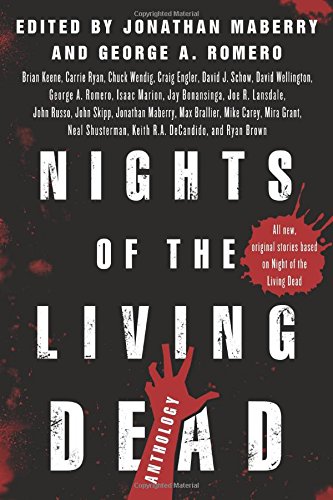
Last weekend I crossed an item off my bucket list and went to (probably the last, or at least penultimate, but who really knows) Living Dead Weekend at the Monroeville Mall in Pittsburgh (aka the filming location of Dawn of the Dead). As part of the festivities, I grabbed this book off the shelf and finally gave it a read. And, what do you know, it's pretty good!
This isn't the first time there's been an anthology set in the world of George A. Romero's ghouls--John Skipp and Craig Spector's splatterpunk epics Book of the Dead and Still Dead: Book of the Dead II both ostensibly took place in the world of those movies, although a lot of the goings-on in those books bears little resemblance to what happened on screen in Romero's (at the time) trilogy. These stories all take place (mostly) right around the first 48 hours or so of the dead coming back to life, and many incorporate elements of Night of the Living Dead's setting and characters.
These writers do a great job of making the setting properly indeterminate: Although about half of the stories clearly take place in an indeterminate mid-60s to mid-70s milieu, and Wellington's ISS-set story has to take place sometime between 1998 and "now" (that is, 2017), most of them feel like they could work both in 1968 and in 2017 or 2026, and there's little to no trickery around getting rid of phones or the Internet to make that work. The stories just...exist. And they're good, and let's talk about them!
Dead Man's Curve by Joe R. Lansdale
Synopsis: A hotrod drag race collides with the living dead.
Thoughts: Lansdale's no stranger to zombies, but this is more realistic and grounded than, say "On the Far Side of the Cadillac Desert with Dead Folks." In fact, it's down-right straightforward, with the proviso that, for Lansdale, "straightforward" still entails stuff like fighting ghouls on horseback and dragging the body of an asshole behind your hotrod as zombie bait. It's a good crowd-pleaser of a story, and while I'm not a huge fan of the ending, it does capture a bit of the indeterminate optimism/pessimism of the "happy" Dawn of the Dead ending.
Clever use of Legionnaire's Disease, by the way.
A Dead Girl Named Sue by Craig E. Engler
Synopsis: The rising of the dead gives both criminals and cops an opportunity to settle scores and tie up loose ends.
Thoughts: I came to this story having already seen the Creepshow adaptation, which I loved. If you've already seen that, this is about the same, although it's interesting that the sheriff's posse in the Creepshow version is almost pointedly multiracial, presumably to make us feel better about rooting for a lynch mob (especially considering the inescapable, if allegedly unintentional, racial overtones of Night of the Living Dead's ending). That's not present here (well, not necessarily--you could interpret any of the characters to be from any particular demographic you'd like), and in fact this story mostly tends towards problematizing the extrajudicial justice angle, whereas the Creepshow version, naturally, leaned into the EC Comics, "Justice has been done. . .from beyond the grave!" elements.
Engler's original, though, puts more focus on the revulsion many (but, crucially, not all) of the participants have for their actions, and I think that's the stronger and darker reading. I would have ended it a paragraph or two before the smirking conclusion. Still, this is good stuff.
Fast Entry by Jay Bonansinga
Synopsis: A psychic who works for the government finds herself reading the minds of the dead.
Thoughts: Running into Bonansinga here felt like meeting an old friend. Bonansinga's solid tale "Animal Rites" from the 1990s appeared in The Best of Cemetery Dance, which I've mentioned before was a touchstone for me as a teenager getting into modern horror fiction beyond just King and Koontz. As a result, anyone who was in that book, as well as a couple of others (the first two volumes of Masques; 999) forever holds a place in my head.
Okay, but how's this story? It's mixed. I'll get into it below with the Maberry story, but I generally don't like an endless amount of spec ops types blowing away zombies and all the attendant military-thriller nonsense. I'm a Romero cut of Dawn of the Dead kind of guy, not an Argento cut guy (and, to my American readers, next time sometime some European acts smug towards you, feel free to point out that it's the American cut of Dawn that contains most of the humor, social commentary, and character work, and that it was supposedly sophisticated Europeans who thrilled to Argento's splatterfest version. . .).
However, Bonansinga has a clever angle here--his heroine's addictive personality, and its relationship to her psychic powers initially seems like a character trait, but it evolves and grows over the course of the story to become the key plot element. It's kind of elegant by the time we get there.
In That Quiet Earth by Mike Carey
Synopsis: A researcher experiments on corpses and himself with hypoxia to determine the exact moment of reanimation.
Thoughts: A touching, romantic story; leave it to a Brit to give everything a touch of class, complete with an Emily Brontë epigram. My synopsis makes it sound like Flatliners, but it's closer to the science fiction elements of I Am Legend.
Elsewhere here (heck, in the story right above this one!) I say that I'm not a fan of pure survivalist fiction, zombie or otherwise, but. . . Here, though, I could have used a little more of it, because it's not clear how our hero manages to bop about the city unmolested by the dead.
It's not a huge deal--as the poignant ending makes clear, Carey is interested in a quieter approach to the living dead than the blood'n'guts we'd expect, and this more emotional and intellectual tale stands out.
Jimmy Jay Baxter's Last, Best Day on Earth by John Skipp
Synopsis: A white supremacist sees the zombie apocalypse as the signal to start a race war.
Thoughts: Edgy--but good edgy, until it gets a bit too zany. The problem here is that Skipp's not sure just how unpleasant Jimmy Jay Baxter's supposed to be. "He wants to start a race war, I think that settles the unpleasantness question." Sure, but then he's practically downright cordial towards the non-white people he encounters en route to shoot up a mosque (which comes up as even more chilling now than when Skipp wrote this in 2017).
Certainly that's true to life about many racists, who may make allowances for "the good ones" among the groups they hate in general. But Baxter's not just a common-or-garden racist, he's explicitly a violent and militant one. Wouldn't it have been grimmer, and more in keeping with the "zombies are a survivable threat as long as humanity doesn't hamstring itself, but we usually will because we suck a lot of the time" theme in Romero's Living Dead movies, if Baxter had executed the black guy anyway?
As it is, we have our William Luther Pierce wannabe here pulling more punches with regard to his race war than, say, Wooley the racist SWAT cop in Dawn of the Dead ("Wooley's gone apeshit, man!").
The climax is a bit too goofy, as well--a crossfire between white nationalist militia types and heavily-armed militant members of the local mosque feels like a level from Postal 2. And, hey, Postal 2 is a guilty pleasure of mine, but there's a better, darker story lurking here, one that isn't glib and that focuses on the willingness of people to embrace their hatreds and prejudices even when facing the sort of threat that should make us all realize that we're all in it together.
It's a problem I sometimes have with Skipp, which is that his stuff is never bad--it's always entertaining while you're reading it--but it doesn't always live up to the promise of the premise and the early bits.
John Doe by George A. Romero
Synopsis: There were a lot of places you wouldn't want to be when the hungry dead reanimate, but an autopsy room would have to be top of the list. . .
Thoughts: I've never read anything Romero actually wrote--I have a copy of The Living Dead that he co-wrote with (Pulitzer Prize winner) Daniel Kraus, but that's a big brick of book, and the couple times I've flipped through it, it seemed dense and overly technical.
Romero's story here hits all the notes of the splatterpunk tradition that he unwittingly inaugurated with Night of the Living Dead (and then helped solidify by giving his blessing to the Skipp & Spector anthologies). That it's violent and grisly goes without saying, but it also covers the bases of what to me makes a work splatterpunk and not just extreme horror: There's a fun, punchy aspect to the writing, vivid descriptions, an ample amount of irony and humor, and more than a little social commentary.
I want to touch on that last part, since it gets to my gripes around social commentary in horror.
Everyone knows the Garth Marenghi line, "I know writers who use subtext, and they're all cowards." But too often I find in horror that the social/political subtext just becomes the text, and you have big allegory monsters running around (I'm looking at you, 'elevated horror'). Something that's refreshing in Romero's work is that that the subtext never overpowers the text of "Hey, this is a crazy movie with zombies and firearms." Yes, Night of the Living Dead has political and racial undercurrents, yes, Dawn of the Dead parodies consumerism (I think it's actually illegal to talk about Dawn of the Dead without mentioning the consumerism satire in the first three sentences). But these things enhance and deepen the movies; they don't determine everything else.
That's what happens in "John Doe." There's a political and racial element which explains why the autopsy is happening, and gives us a sense of the character and the world he lives in: The Hispanic medical examiner is upset the police dragged their feet on calling help for the Hispanic decedent (on at least partially racial grounds), and wants to find evidence the man could have been saved and the cops screwed up. But, this story isn't about American race relations and police violence; this isn't the center of the story. They're just elements to the story which enhance it and give it additional flavor and merit and complexity.
Which is not to say a zombie story with those issues front and center couldn't be powerful as well (the first segment of Tales from the Hood comes to mind, but I'm sure there have been others); it's just that it's nice to see a story with those elements that takes them seriously but isn't overdetermined by them.
Mercy Kill by Ryan Brown
Synopsis: A soldier's homecoming from Vietnam is spoiled by the rise of the dead and vindictive local law enforcement. His solution to both problems is to disguise himself as a ghoul, but that has its own complications.
Thoughts: Spoilers!
I love happy endings, but this is a little much. The problem is, the "right" ending to this, where our hero gets shot by the woman he loves, isn't just a downer, but a major retread of NotLD's infamous shock ending. In fact, I'd bet that Brown got part of the idea from the story there.
Fair enough--the point of this book is riffing on Night--but it means that to go a different direction, Brown has to go to some contrived bouts of good luck which undermine the grimness of Romero and Russo's original scenario. I think that's the better move, but it does feel too cheery.
I very much like the appalling notion of people rounding up zombies and bringing them to hunting areas for paid sharpshooting; it touches on some of the ambivalence in the original movies about paramilitary death squads (undeath squads?), and makes one uncomfortably aware of the parallels to historical atrocities without forcing the issue.
Orbital Decay by David Wellington
Synopsis: Living in space is hazardous enough on a good day, but undead crewmembers and a compromised Mission Control make everything worse.
Thoughts: It's fine. For my money, the "Romero zombies in space" theme peaked with the ill-fated astronauts who encountered Star Wormwood in Stephen King's splat classic "Home Delivery." This feels a little contrived, and I also think the epistolary nature of the story pulls some of the punch: Even though our characters both in Houston and in space are doomed, the framing device tells us that someone thought it was worth reconstructing, which implies a future where the zombies are sufficiently neutralized that some official or quasi-official authority has the luxury of historical investigations into the fate of a few astronauts.
Still, Wellington hits the right notes of doom and the "oh wait, it gets worse" stuff you expect from a space disaster, so I wouldn't call this a disappointment. It does exactly what you'd expect it to do.
There's also one very well done bit early on involving a live broadcast to a class of schoolchildren that goes wrong (but not in the two or three ways you'd expect in a story like this).
Snaggletooth by Max Brallier
Synopsis: A woman and her lover plan to kill her husband for the insurance money; the lover stages a "hunting accident," but the police are suspicious. . .especially when the corpse vanishes.
Thoughts: Tons of fun; this is a heavy nod to the EC Comics tradition, which pops up all over Romero's work (most clearly, of course, in Creepshow and Tales from the Darkside). I really enjoy stories like this, or "Dead Girl Named Sue," or Richard Laymon's "Mess Hall," where real world murder and crime intersect with the pesky tendency of the dead to stand back up.
Brallier's story reaches beyond that though to the 19th century, and grabs some of the spirit of Edgar Allan Poe. In some ways this is a Romero-riffic retelling of "The Tell-Tale Heart", right down to an offending body part being part of the motive for murder (but here it's a tooth, not an eye). The key difference is that in Poe's story, the old man's heart was very much dead--but the body the guilty narrator sees shambling across the back yard is. . .well, also very much dead, but markedly more mobile. Highly recommended.
The Burning Days by Carrie Ryan
Synopsis: A group of vacationers use literal firewalls to keep the dead at bay, but patience and fuel are in low supply.
Thoughts: Hell is other people--both living, and dead. The zombie action is good and exciting, and so is the feeling of doom. Spoilers follow:
Ryan pulls off an impressive magic trick--from the jump, you're focused on the material problems (the dwindling fuel supply, the number of zombies), and the interpersonal conflicts, but the interpersonal conflicts seem like they're mainly relevant for how they threaten to make the material problems worse. The masterstroke here is that, at the end, the material problem is solved, and we should feel relief, except now we're stuck with those interpersonal problems. . . forever.
Very good.
The Day After by John A. Russo
Synopsis: A further look at the zombie outbreak in Western Pennsylvania, picking up immediately after the last scene of Night of the Living Dead.
Thoughts: Hey, lookit THIS!

The important context here is this is an adaptation of the second half of a screenplay Russo and Romero wrote. A novelization is one thing, but reverse engineering a screenplay is another (although, I have to say that Rod Serling's adaptations of Twilight Zone scripts were quite well written, so that can't be a full excuse). What we get is a lot of action and description, but no real psychological depth to anything that happens; events just pile up one after the other.
But, as a story--this is good stuff. It follows on logically for the most part from the ending of Night, and there's a bit involving a bunch of Catholic schoolkids that's shocking and taboo-busting without seeming gratuitously meanspirited. Good stuff, and I defy you not to imagine it in black and white while you read it.
The Girl on the Table by Isaac Marion
Synopsis: A close look at the mind of young Karen Cooper, before and after her zombie bite.
Thoughts: The most "New Horror" (as opposed to just splatterpunk) story in here--the focus is less on the literal "facts as we are reporting them to you" and more on expressing the subjective psychological state of poor Karen as she dies from a zombie bite. I don't necessarily buy the idea of 'zombification as liberation,' but Marion does a great job of developing the characters of the Cooper family from the movie in a logical way. Moving, scary, and well written.
Williamson's Folly by David J. Schow
Synopsis: The unfortunate events befalling a small Nebraska community after a space probe crashes downtown.
Thoughts: More restrained than Schow's splatterfests from the Book of the Dead series, and not-coincidentally, better than two-thirds of them (the exception being the absolute overkill that is "Jerry's Kids Meet Wormboy"). Which is not to say that Schow stints on the gore, the humor, or the playful, intense style that makes his work stand out.
Where the story gets most interesting is when it becomes a variant on The Crazies, with a "local cop's authority usurped by not a particularly helpful military presence" plot element, and also gets at one of the truths about the conspiratorial tendency in politics: Imagining any person or cabal in control, no matter how sinister, is psychologically preferable to a world where things just happen.
You Can Stay All Day by Mira Grant
Synopsis: A zookeeper tries to protect herself, and her animals, from the zombie outbreak.
Thoughts: I was excited for this one because I knew Ellen Datlow had picked it for one of her Best Horror of the Year collections, but this didn't live up to my expectations. There are a few good bits here--the image of zombie victims reanimating on a carousel and riding it indefinitely is cool; it feels like an image that would have been in Dawn of the Dead. And the ending is good...but this doesn't do it for me. A decent amount of things happen, but it's never as much as it feels like happened.
I do agree with Grant's heroine about it being unfair to put down wild animals just because of how they act when someone jumps in their cage, though (assuming the person's already beyond rescue, that is).
Pages from a Notebook Found Inside a House in the Woods by Brian Keene
Synopsis: A gang of armed robbers find refuge from the dead in a farmhouse. Unfortunately, it's haunted.
Thoughts: The monster mash-up is one of the great traditions of horror fiction, and here Keene puts two types of undead in the same story. It's brilliant.
There's an economy of novelty here that I admire, and it's about to seem like I'm going to call Keene's tale shallow, but I mean NOTHING of the sort. The zombies here are just zombies; they don't do anything all that interesting, expect kill messily and sometimes "die" messily. The ghost also doesn't have a lot of motivation, nor does it do much outside the standard haunted house playbook. But--it doesn't need to, because seeing how the two interact is a lot of fun.
In particular--the antics that ghosts get up to, like opening doors or trashing property are generally harmless. But, in the context of a zombie apocalypse, these things become matters of life and death.
Recommended.
Dead Run by Chuck Wendig
Synopsis: A truck driver plans to help survivors with a cargo of food, but his brother has other ideas.
Thoughts: Swing and a miss. The writing's fine--more than fine, actually: As I think about it after the fact, I really don't feel that this story works well (sorry, Chuck) but the fact that I'm still favorably disposed to it means something.
I like the optimistic tone here as well, but the story spends too much time on generic family conflict and not enough on anything interesting.
Lone Gunman by Jonathan Maberry
Synopsis: A member of a special forces team finds himself trapped in a mass grave during anti-zombie operations.
Thoughts: I still have fond memories of Maberry's Patient Zero, and this reminded me why, but ultimately I just don't find hyper-competent special forces operators that interesting. Even (especially?) when they're fighting zombies.
It's conventional zombie action, and it's fine as far as it goes, but I'm not compelled by it. If you like that kind of thing, I think you'll love this. For me, the scariest and most exciting part is the beginning in the mass grave, and that's great. However, the better things go for the main character, the less interesting they get for me.
Live and On the Scene by Keith R. A. DeCandido
Synopsis: A Jewish television reporter grapples with his family, his identity, and the living dead.
Thoughts: Like Wendig's tale, there are two different and interesting stories, or parts of stories, here. A story of the outbreak from the point of view of reporters on the scene would be good--you could go either the [REC]/Diary of the Dead angle of getting caught up in the action, or tap into the power of the great early WGON-TV scenes in Dawn of the Dead where we see society's deterioration from the chaos. There's a small element of both of those things, but not very much.
We also have the Jewish angle--our hero's suppression of his Jewish identity because "they'd never let a Jew on the air," and the tensions it's caused with his father. That's interesting material, and it gets more interesting when the need to incinerate the bodies of the newly dead rubs up against the Jewish ban on cremation.
The problem is that everything feels like set up for something, but the actual climax is just an amalgam of three or four different zombie tropes you've seen before. The result is a story that's less than the sum of its parts, and a missed opportunity.
By the way, I asked some of my Jewish friends about the cremation point, and they all agreed that the principal of pikuach nefesh, as explicated in the Talmud, would permit the breaking of religious proscriptions against cremation to save a life.
Deadliner by Brendan Shusterman and Neal Shusterman
Synopsis: With the living dead epidemic under control, a zombie-slaying hero reinvents himself as a circus showman.
Thoughts: A weak end to an entertaining book, unfortunately (really, the last great story in here is Keene's, and that's several tales back). "Zombie Circus" should be a slam dunk, considering the successes of Gahan Wilson's "Come One, Come All," , Joe Hill's "Twitterings from the Circus of the Dead," and whatever the hell is going on in the last third of Junji Ito's Gyo. Alas, this doesn't hit at all--it consistently yaddas over the best parts and most intriguing concepts.
The best idea in here hearkens to the Dawn of the Dead 2004 "Hollywood Squares" scene, and the reveal of the star zombie is a fun throwback that would send many of J.G. Ballard's protagonists into paroxysms of post-modern perversion. Otherwise, it's just not very interesting.
And while a zombie circus is a truly reckless idea, I'm not convinced that the outcome will be a full-blown new epidemic. If we managed to get the zombie problem under control back when we didn't know how it all worked, we'll probably be able to do it again.


Comments
Post a Comment