See That Girl, Hear That Scream, Best Horror of the Year Seventeen: The Best Horror of the Year Vol. 17 (ed. Ellen Datlow) Part I
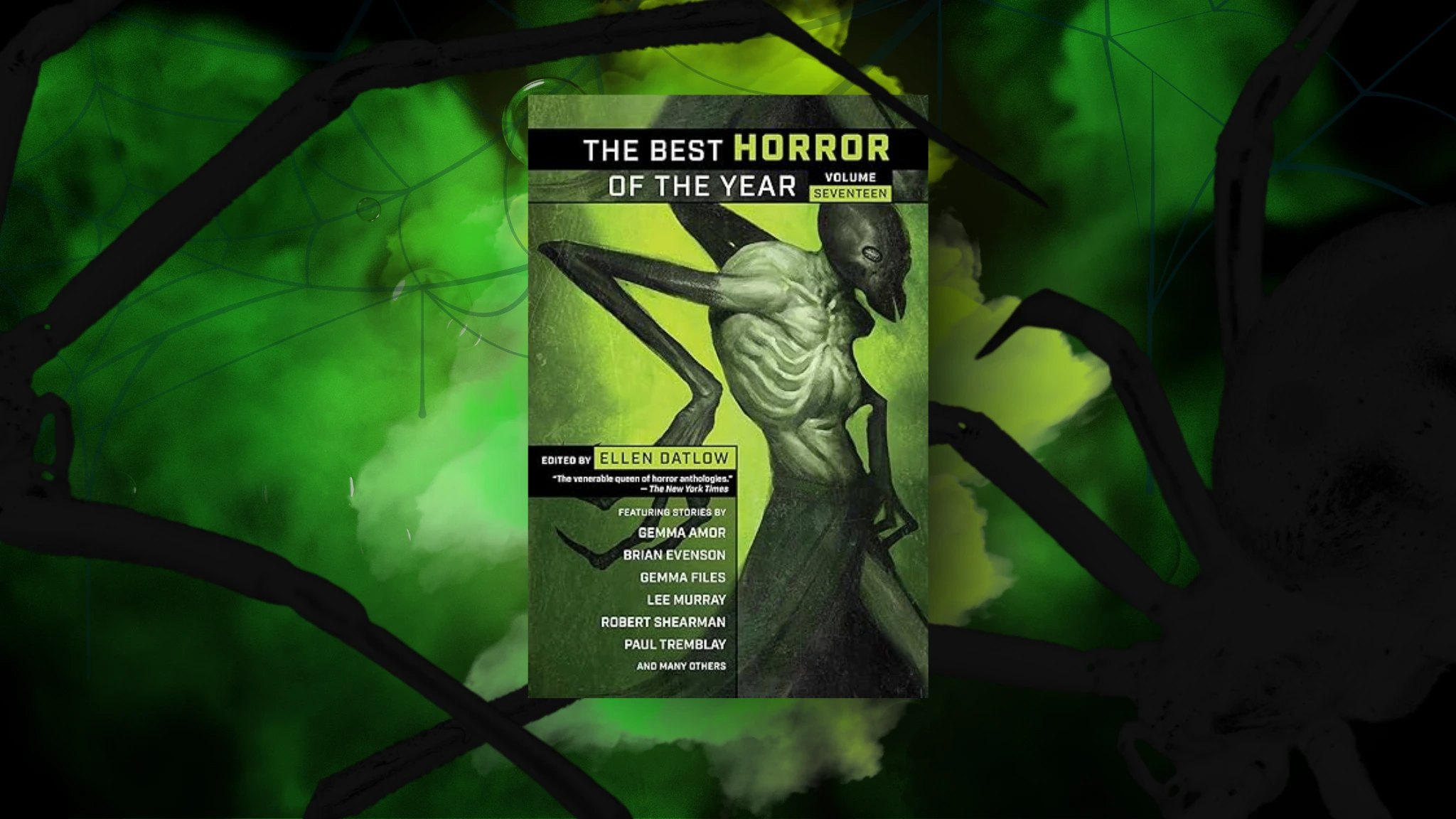
I've written before about the mixed feelings I had when I was getting back into horror fiction after college and I encountered the first few of Ellen Datlow's The Best Horror of the Year series (something of a spiritual successor to her important work on the Year's Best Fantasy and Horror series). "Where's the horror?" I asked myself at the time. In retrospect, I think it was always there and I needed to expand my notions of horror a bit.
No mixed feelings today, though: The first half of this book is great (the second half is too, we'll get there next week), and there's no question here about where the horror is. It's here (and, just maybe, right behind you as well. Don't look!).
The Cleaner by Victoria Dalpe
Synopsis: A special cleaner has to mop up the mess after urban predators claim another unfortunate squatter.
Thoughts: A good start to the book. This scratches my itch for the splatterpunk/new horror/Dell Abyss 'edge' factor. There's an authentic punky energy here, which is something I've seen in some of Dalpe's other work, too. I dig it!
Second--the 'ecology' of horror here is clever in a way I rarely see in horror fiction. Cryptids or lost races or molemen are still just animals. While SF usually focuses on the parts where they eat (and, sometimes, mate), there's so much that can be done involving the interconnections among animals and their evolutionary niches. The part rivalry, part symbiosis between the "Night Shift" (by the way, it's cheeky as hell to write a story about man-eating monsters under an old New England mill and name them "Night Shift", but I like it) and the Cleaners makes sense, at least on the level of environmental science and biology.
There's also snatches of Etchison at the edges here. Some of it is the nature of what the Cleaners are up to, which reminds me of the organ harvesters in my favorite Etchison story, "The Machine Demands a Sacrifice." That's more of a cosmetic similarity, though. More important is the way that (as in Etchison stories like "Deathtracks" and "The Spot" and "Sitting In The Corner, Whimpering Quietly") the titular cleaner is only seeing a part of someone else's horror story--here, we're coming in after the fact of whatever happened to the artist in his ill-advised squat, and we may be leaving right at the beginning of another horror story involving the guy's girlfriend. This is an effective method, because it allows for a satisfying story with a beginning, middle, and end with the main character, but also allows for hints and innuendo and the uncertain feeling of thwarted catharsis for the storylines the author doesn't fully play out.
Summer Bonus by Lee Murray
Synopsis: Kate and Laurel leave England to take a summer job on an isolated New Zealand farm. There's no phones allowed (and no pay), but there are some compensations: Beautiful beaches, hunky coworkers--and the chance for a "summer bonus."
Thoughts: Sun-scorched nastiness but polished to perfection. This reminds me a little of a Pan Book of Horror Stories sort of tale--specifically, the ones with sex and violence (often against women) that earned them an increasingly tawdry reputation during the second half of the 20th century. However, while the scenario would be at home in a PBoHS, Murray's approach is restrained and sophisticated. It isn't that she's primly trimming the sex and violence (there's a bit of both, so don't worry, sickos); it's that what makes the story effective is the cruelty of the scenario itself, and less the exploitative inducements.
The only weak link is the inflection point in the story when we learn about the titular bonus and how to earn it. In many other stories, you can force the issue of the inflection point because the horror forces itself upon the characters and the situation, so they have to just "go with it." But here, the "bonus" requires action and buy-in from the characters, and I wasn't quite sold on Kate's transition from point a to point b. However, that part isn't so weak that it compromises the rest of the strong story--Murray puts in enough that it seems plausible, and I'm willing to give her the rest since it's a horror story, but it's worth noting.
Like Furies by Epiphany Ferrell
Synopsis: A grieving artist doing a summer residency in a small town uncovers the secret of the Bird Woman.
Thoughts: Great opening, here. It's like an X-Files cold open in all the right ways. I generally enjoyed this story a good deal; it's a creature feature with some additional emotional depth. The way the town deals with the Bird Woman seems plausible; for once, we have a small town with a dark secret where the ambiguous and intermittent nature of the threat makes the cover-up more feasible. The "special effects" and action are good, too. I'm not entirely sold on the ending, but that's a quibble.
Body Worlds by Tom Johnstone
Synopsis: Catherine and Robert are on a European tour to fix their marriage after Robert's infidelity. But every tourist trap just piques Catherine's anger, jealousy, and insecurity, until things come to a head at the Body Worlds exhibit.
Thoughts: One of those stories where the horror elements are the weakest part. Johnstone paints a plausible, grim picture of a union crippled by betrayal. Catherine in particular is well-drawn--haunted by insecurity and anger, and then second-guessing herself with the idea that she's being unfair, and then triple-guessing herself as to whether she's not just being manipulated by her husband. It's a good portrayal of an emotional house of mirrors that's as unpleasant a place to visit as the tourist traps the doomed couple haunt in Europe.
I like how the themes come together in the end, and I think Johnstone has the right idea by having the "mechanism" that triggers the climax be a sort of monkey's paw thing. But it mostly feels like what you'd "expect" if you're a seasoned horror reader and you're coming to a story about preserved human cross-sections and the like. Especially if you've seen the first two Hellraiser movies.
Does that make it a bad story? Gosh, no. It's great. I do sometimes feel like I carp on the things in otherwise great stories that I don't like, but I don't mean it in the spirit of nit-picking. I find focusing on the parts of a story that didn't do it for me on the first read are usually the entry points for me to figure out what I was looking for in the story and understand how and why it "works" better.
An Act of Sorrow by James Cooper
Synopsis: A professional mourner receives a lucrative but bizarre assignment involving a wealthy dead man. Well, mostly dead.
Thoughts: Professional mourner is already a good hook and it's been done well at least once before, in an early-ish Harlan Ellison story ("Mourners for Hire" AKA "We Mourn For Anyone"). I'm sure there are others, too. In one sense, it's the weakest part of the story for me: When Reed's confronted with his latest client, he undergoes a whole "I'm the monster! I'm an emotional fraud! What's before me is the only real suffering!" Which. . .I'd have a strong reaction from seeing a half-dead guy as well, but this hand-wringing feels unearned (and I don't think we're distanced enough from Reed's character in the story to story).
I understand that the professional mourner angle also lets us see the Carew family's affliction through the eyes of an outsider, but I feel there are other ways to accomplish that. For example, have Reed be a man who's married into the family. Have part of his initiation be destroying his grandfather-in-law, and then realize with horror that one day he'll have to do the same for his wife. . .
Everything else in the story is great: The buildup is uneasy, especially when we get to the upsettingly titled "Treatise Concerning the Screaming and Chewing of Corpses in their Graves." And the execution of the payoff is classy and bloody and subtle and visceral and any number of great, contradictory things. But we're in the presence of the living dead, so we already have the greatest contradiction of all in front of us. Great stuff.
Oh. . .that treatise about the "chewing dead?" That's real. Pleasant dreams.
Fancy Dad by David Nickle
Synopsis: Coworker couple Rick and Saffron end up taking care of their disgustingly drunk boss and his unpleasantly seductive younger daughter while vacationing in Muskoka. But who's really in charge?
Thoughts: An odd (but good) one, with a great set up that goes from "funny" to "uh-oh" to "oh no no no," but then takes a couple of wild swerves at the end. Those swerves are well-executed, and elicited the desired gasps and chuckles from me. And that's a success itself--but I didn't feel all that horrified. It's really more fantasy than straight-up horror, I think. I do wonder whether more familiarity with Canada would help here, since while I "get" the story I think there's stuff about Muskoka I'm missing.
Only Children by Gemma Files
Synopsis: Sera can photograph the boogeyman, a talent she discovered too late to save her childhood friends. But, she's determined to keep her son safe.
Thoughts: Files's tale is a fun twist on the whole Slenderman idea of 'this creepy figure is showing up in the background of photos.'
We're essentially playing Pokémon Snap here, but for boogeymen. That's a fun idea, and there are loads more ideas in here--many of them pleasantly not fun, such as the There isn't a ton that actually happens in this story, but that's okay. There's loads of great ideas--the part where Sera makes on-demand death tableaux for creepy fetishists on a no-names basis could be its own story, and Sera's own run-in with the boogeyman could too. As it is, they're parts of a satisfying, spooky stew.
The Rock Statue by Mark Falkin
Synopsis: Six suburban women on their yearly weekend getaway cross paths with some disaffected locals.
Thoughts: An all-female The House on the Edge of the Park with suburban wine moms as the heroes/victims/are-they-actually-victims? is a good idea, and Falkin builds the tension well, particularly in the "early creepy encounter with locals while getting supplies at the gas station/grocery store" scene, which seems mandatory for these kinds of stories.
I have mixed feelings about the supernatural elements. Falkin introduces them early enough that it's not a total surprise (and the table-turning that ensues does fit with the House on the Edge of the Park/Venus Flytrap setup), but it does feel a little. . .convenient. But these are quibbles; this is a great story, one of my favorites here.
In Flickering Light by Dan Coxon
Synopsis: A film editor reminisces on his work with the legendary director Will Purslane--and the horrible secret of his special movie projector.
Thoughts: This story has one incredible central image--a celluloid version of "From Beyond" that also has notes of David Morrell's classic "Orange Is For Anguish, Blue For Insanity." And, this scene is almost enough to carry the story. However, there isn't enough meat on the bone otherwise. The Ealing Studios vibes are interesting, and I suspect if I knew more about mid-century British cinema I'd get a kick out of it.
But we're not here for BFI inside baseball; we're here for horror, and there isn't quite enough here. Still, we'll always have that beautiful, horrible scene.
Davidson's Son by Charles Wilkinson
Synopsis: A gangster goes to ground in the country after the accidental death of his lover--the crime boss's son. But his hideout has its own dangers. . .
Thoughts: Cliff McNish's story (which we'll get to next week) explicitly shouts out Robert Aickman, but this story is Aickman-esque as well. The whole story is a mist of vague fears and strange things and the inexorable approach of doom. And "mist" is the right way to think about it--this story is concerned with noses and lungs. The smell of baking bread is a key manifestation of the supernatural phenomena at Cooper's hideout, as is gas. Cooper's deliciously odd neighbor speaks of needing to keep the sadness and terror of the old hanging ground sequestered in the earth to prevent a miasma of evil from "leaking upwards. . . and into our air." Hanging itself implies strangulation, of course. And, while we're not privy to the details of how Davidson's son died, Cooper says "[a]n adult experiment to which they'd both consented had gone wrong." So. . .erotic asphyxiation, perhaps?
All of this accretes and builds into a thick fog of dread, and if the climax lacks the snap of some of Aickman's best pieces, it's scary and satisfying.
The Boy in the Closet by Douglas Ford
Synopsis: Mr. Mears' class insists that his mean predecessor caused a student to die in the classroom closet. They're telling tales, surely, but it's starting to get to him. . .
Thoughts: Maybe my favorite story in the first half of the book. This is straightforward horror, with a simple premise--SPOOKY GHOST KID--prepared perfectly. Ford plays on several tensions at once--there's the tension of the ghost, of course, but then there's the tension between our protagonist and his class (will they push him too far? what will he do?), and the sexual tension between him and his coworker. Ford pays it all off, too, with a hysterical climax and a closing that slaps you across the face.
There's a moment in this where Mears counts and then recounts the number of students in his classroom, and the number seems "right" although based on some other evidence, the number (and everything else) is very much wrong. It reminded me of a similar part in John Burke's "Lucille Would Have Known," and indeed I think this whole story would have fit well into one of Burke's Tales of Unease anthologies. Like the stories in those, it combines literary quality and class with a nasty streak that powers up the material.
That's a great stopping place--so we'll be back next week for Round 2!


Comments
Post a Comment