Here Waits Thy Doom: Doom City (ed. Charles L. Grant.)
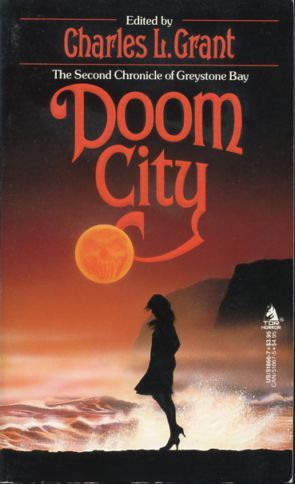
Happy New Year! Let's start things off with a return trip to Greystone Bay--Charles Grant's creepy seaside New England town, and the setting for four shared-world anthologies in the 1980s and 1990s. I love these books; even if the story quality is variable (as is usually the case with an anthology), the cumulative impact of these foggy, damp streets and creepy old houses is effective. Let's get to it!
Introduction by Charles L. Grant
Synopsis: A quick (re)introduction to the haunted town of Greystone Bay, as painted by local artist Tom Blouseter.
Thoughts: Just what we want--an amuse bouche with a bit of foreshadowing of the contents to come.
Sometimes Grant's stories, oddly enough, remind me of Lucio Fulci. The approaches are different--Fulci's most famous works involves splatter and maximalism, whereas Grant is associated with the opposite in the form of "quiet horror" (these things are all relative, of course--my second favorite Fulci is the quiet, classy The Psychic while in his turn Grant sometimes turned in nasty stories like "Eyes"). However, both of them have stories that lean into a type of "anything can happen" irrationality, where what happens is often tied to the magic of location. In these locations--whether Fulci's Gates of Hell or Grant's Oxrun Station and Greystone Bay--bodies and minds warp and transform in unexpected ways. That's part of what makes reading a Grant story unsettling--anything can happen.
Shift by Nancy Holder
Synopsis: An aging lobsterman maintains the same lifestyle he has for years, but change is in the air. . .
Thoughts: Maybe the most "Grant" story of the collection; in particular this reminds me of "The Old Men Know" from Masques. The underlying sadness, the age, the despair are all perfect.
Unfortunately, it has some of the weaknesses of that style as well--mainly, it's getting by on vibes the whole time with the promise of a payoff at the end. This is fine as long as the vibes and the payoff are good. Here, the vibes are perfect, and while the payoff is striking (one of the many times reading this book I wished there were a Greystone Bay comic series, and further wished that Berni Wrightson had done it), it doesn't make much sense. The basic parallel of Death taking a life from Greystone Bay every so often, just like the market hunters and the fishermen, is good. The other stuff--the "odd" ducks and lobsters, and the big shock scene that Wrightson would have nailed--didn't really follow on my first reading. Or, for that matter, the second.
Still, this is the kind of story I want from a Greystone Bay anthology (even if I quibble with some of the particulars).
Waiting for the Hunger by Nina Kiriki Hoffman
Synopsis: A therapist who specializes in eating disorders for business, and in his patients for pleasure, finds himself making an involuntary house call on the shores of Greystone Bay.
Thoughts: Like Hoffman's prior Greystone Bay entry, this story doesn't feel like a distinctly Greystone Bay story as such. It is good--weird, but good. There's a creepy liminality to where the story takes place that feels almost like an Etchison story and makes me think of the tremendous cover art--I've raved about Grant's TOR covers before, but the four Greystone Bay books have great ones.
I like it, though. The idea of a doctor whose line of work brings him into contact with people he's attracted to, but in the process of curing them, destroys his own attraction to them, is provocative. Hoffman walks a close line here, neither condoning nor condemning the protagonist (at least, not any more than he condones or condemns his own behavior). He's sympathetic enough that we're kept in suspense by his predicament, but his fate seems appropriate, even if it isn't really "fair."
Doc Johnson by F. Paul Wilson
Synopsis: A young Boston doctor whose career got derailed by a malpractice case is starting over in Greystone Bay. Trouble is, most of his prospective patients are loyal to aging solo practitioner Doc Johnson. Except for one patient, who is terrified of ever seeing Johnson again.
Thoughts: More doctors! Wilson, of course, has been a practicing doctor in tandem with his successful writing career, so he's a natural for this piece.
This is an entertaining story that effectively plays with our sympathies by making both secondary characters (Doc Johnson and the ornery patient Joe Mosely) the subject of our suspicions. Occasionally I find that Wilson's stories stack the deck (to their detriment) in terms of who we're supposed to like and who we aren't, but the more nuanced approach here works. By the end, we're not very sympathetic to Mosely, but his unmaking still raises a chill.
The "unmaking" is literal, by the way, and it's more visceral than usual for the Greystone Bay stories. However, it's not splatter--it's visceral in a way that's consistent with Grant's classy and chilly "shadowpunk" vision.
At the Bentnail Inn by Robert E. Vardeman
Synopsis: A struggling businessman on a second honeymoon is trying to save his livelihood and his marriage. He has enough on his mind without the vagrant scuttling around their hotel, just out of view. .
Thoughts: Our first "meh" story here. By the second page it's clear what's going to happen to the protagonist, although the path the story takes to get there surprised me. Still, this didn't click with me. I think the problem is that how the 'magic' of Greystone Bay works in this story is at odds with the Greystone Bay "vibe." Sure, there's a dark secret tied to the magic of the Greystone Bay location, but the idea that someone (even if it isn't our protagonist) is able to get a happy ending in the paradise dimension seems antithetical to what we're doing here. If anything, it feels like a watered down Harlan Ellison fantasy.
Occupant by Kim Antieau
Synopsis: Peter Gibson has cut his ties to his lover and former colleagues and moved from to Greystone Bay to focus on writing. However, nobody seems to know, or remember, who he is.
Thoughts: The platonic ideal of a Greystone Bay story for me: Literate with well-drawn characters, a creepy quiet horror ambiance tied to the strange location, the subversion of ordinary society into a dark shadow version, all ending with a downbeat ending that has elements of both psychological and physical horror, without being "messy."
One of the most realistic horror tropes is that the person who goes somewhere in order to "get some writing done" is, in my experience, guaranteed to instead do anything but write. In my case, though, it's "drink the energy drink or Belgian ale you gave yourself permission to get as 'inspiration fuel, and then screw around online for a couple hours." It isn't "go nuts in a Colorado hotel" or. . . whatever it is happens to Peter here.
I think the only person who ever did go someplace remote and have a productive time writing was Paul Sheldon, in fact.
Anyway. . .on its face, this is just the same "Disappearing Act" story we've all seen or read before: A person is slowly rubbed out of existence, as their every tie to society either vanishes or refuses to recognize them. However, there are a few wrinkles in Antieau's story that stand out.
First: Peter deserves what's happened to him. He chose to isolate himself from the world to focus on his writing, both physically (the move to Greystone Bay) and emotionally. The fact that he becomes an unmemorable nonentity is the logical result of his actions. It's also a fitting punishment because writing is a way to secure notoriety and immortality--but Peter (and his writing) receive no recognition.
The second is the phone call Peter has with his brother. It's a chilling variation of the American Psycho gag where Patrick Bateman and every one of his yuppie cronies are completely interchangeable. To say more would spoil one of the best moments of the whole book, so I won't.
Finally, there's the way Antieau resolves the plot. "Help, I'm becoming nobody" plotlines have a standard progression, and Antieau generally follows that. However, these sorts of stories can struggle with an ending. Antieau solves that with a neat touch of body horror that may, if I read it right, add an additional element of poetic justice to Peter's fate.
Prayerwings by Thomas Sullivan
Synopsis: Their first mistake was picking Greystone Bay for their honeymoon. Their second mistake was delaying their wedding night festivities in favor of a walk to the cemetery. Their third mistake was entering the tomb in the center with the host of butterflies.
Thoughts: A caged grave in the center of a cemetery, containing swarms of deadly butterflies. This is the sort of surreal combination of beauty and quiet terror that, to me, exemplifies the majesty of Charles Grant. Sullivan does the concept justice, as well: The scenes in the cemetery are exciting and evocative and great.
So, how's the rest of the story? Lots of fun. Something that's impressive about this story is that it operates in three different registers. There's the aforementioned eerie beauty, but there's also a healthy element of sexually-based body horror with a tongue-in-cheek tone--you could slide this into one of the earlier volumes of the Hot Blood series.
Finally, there's the "small-town conspiracy/mystery" angle, and while the story hits all the expected beats for that plotlines, it does so in a way that's satisfying, not tiresome. It helps that heretofore the Greystone Bay of Doom City has mostly been "creepy New England town where weird things happen," but Sullivan returns us to its roots in the town's creepy founding families. A highlight of the book.
An Overruling Passion by Galad Elflandsson
Synopsis: Michael Rawdon, successful NYC lawyer, has chased his wife of 18 months to her hometown of Greystone Bay. He's devoted to her, she's in love with him. . .but her aristocratic father has summoned her home, and Rawdon wants her back.
Thoughts: Elflandsson delivered the sleeper hit of volume one with "Something In A Song", which was a sensitive, small-scale dark fantasy with emotional resonance. This story is more soap opera Gothic, and Elflandsson has a way with the images: Meetings in posh hotel bars, chauffeured black cars, tense family confrontations in secluded estates.
The end, though, isn't satisfying. Just as Elflandsson's introduced unsettling intimations of violence and sexual perversity, he yaddas the best part for a disappointing reveal and one of horror's oldest cliches. Although, some might say the fact that Rawdon's a lawyer should have tipped us off about the reveal from the start.
The Supramarket by Leanne Frahm
Synopsis: Helen has doubts about shopping at the massive Supramarket, but her friend Sally brings her into the fold.
Thoughts: I sometimes like to imagine hyper-specific 'anthologies' which would just be two or three stories. For this one, I'd slam "The Supramarket" together with Wendy Webb's "Midnight Madness" from Women of Darkness for The Bourjaily Book of Slightly Underwhelming Horror Stories By and About Women in Alienating Modern Stores That Were Originally Published in Late 1980s TOR Anthologies Edited by a Member of the Grant/Ptacek Household.
I say underwhelming, because this story does nothing new. I like it--I enjoy this kind of story--but I do tend to find anti-consumerism allegories are generally tiresome: The targets are easy and the paths are well-trod, even if the message is worthwhile.
However--the details and the execution here are good. Frahm takes the frenzy and hostility and alienation that can all occur in the modern supermarket and fuels a quick-paced and compelling story (I've had similar experiences grocery shopping in Boston). I just wish there were a little more to it.
Jendick's Swamp by Joseph Payne Brennan
Synopsis: Two men investigate Jendick's Swamp, and fall afoul of monsters both human and otherwise.
Thoughts: We have a shared-world overlap here, as Ithaqua (a kind of Wendigo-like entity) is a Cthulhu Mythos figure.
Brennan's story was a high point of Greystone Bay, so I had high hopes for this one. And it delivers. Like before, Brennan's story has a chummy, breezy feel to it. It's not a comedy, although it may be tongue in cheek (at least in part).
What we have here is a classic Weird Tales story (two guys investigate a spooky swamp and a spooky house, and spooks spookily spook them), but with the overly ornate and po-faced prose stripped away. Instead, we zip through the plot points and action scenes with economy. There are times when I think the story is almost too pared down and it resembles a recap of a Call of Cthulhu RPG session. But, Brennan gets in and out and gives us the goods. You can't argue with success.
Fogwell by Steve Rasnic Tem
Synopsis: His parents are Greystone Bay born-and-bred, but young Willis was born during a visit to Chicago. Maybe that's why he doesn't get along well with the rest of the kids at school.
Thoughts: A relatively straightforward story here from SRT, compared to some of the other stuff of his I've read recently. Not a criticism (this is a good story), just an observation. By straightforward I mean that where Tem's writing often has a mingling of psychological and supernatural elements in the service of both allegory and literal horror, this is a 'straightforward' horror story where the inexplicable elements are the standard sort of supernatural points. In short, you could approach this story as "just" a work of supernatural horror and come away satisfied, whereas other SRT stories defy that sort of approach (for example, "Out Late in the Park" or "At the End of the Day").
I'm glad to see the stories make more use of the fog that's such a part of Greystone Bay. Fog (and its brother mist) are horror fiction mainstays. Just think of James Herbert's The Fog, John Carpenter's The Fog, and Stephen King's The Mist. The fog conceals threats, but it transforms things It's no mistake that the three examples I cited of famous fog/mist horror stories all involve a degree of transformation of the everyday into the horrific. Here, the transformation is the opposite-- Willis is being made "normal" by the fog--he's going to fit in.
Of course, normal for Greystone Bay is terrifying anywhere else.
Here's where the allegory comes in (just because this is a more straightforward SRT story doesn't mean there's not an allegorical or symbolic element), since I think Tem is suggesting that normal for anywhere else is also terrifying. Willis is a sensitive, introverted kid with a rich inner world--I found myself identifying strongly with him, and I imagine some of you reading this blog would too. He seems to be the only one willing to think beyond the insular community he belongs to and dream of beautiful and different things--right up until his fogbotomy.
Dead Possums by Kathryn Ptacek
Synopsis: Hank's marriage to Mary-Ann is dissolving. She's become a militant animal rights activist, and she may also be cheating on him. He drives out to confront her, but there are bumps in the road ahead. . .
Thoughts: This is a strange story, and a slightly frustrating one. Frustrating because it is very well written, and sets up an effective conflict between Hank and his animal-addled wife. It also has an effective ending--conceptually horrific and crisply written (just because it's quiet horror doesn't mean it can't punch you hard). However, there is a disconnect here--it feels as though there are two different stories.
Part of it is that the ending I praised so much involves a hellish inversion of circumstances, which I associate with an EC-style poetic justice ending. In other words, there's a moral element to the ending. But, regardless of one's thoughts on animal rights, Mary-Ann is just behaving dreadfully, and all our sympathies (at least, mine) are with her long-suffering husband. This doesn't mean that he can't have a bad ending, of course. One of my favorite classic horror stories is Dennis Etchison's "Wet Season," which is a similar "sympathetic dad against mom and possibly kid(s)" scenario and that dad doesn't deserve what happens to him. But Etchison's story is more of a weird tale that exists outside of a moral framework, whereas the whole focus of the story is rights and wrongs--both human vis-a-vis animals, and humans vis-a-vis each other.
It is the case that, by the very end, Hank is starting to engage in the sort of behavior that could lead someone to "deserve" the end he gets. But, in that case, the conflict with Mary-Anne, which has been the focus of the entire story up to this point, feels like a red herring.
But, damn. That ending rocks.
The Grandpa Urn by Bob Versandi
Synopsis: Sean Calder wants to know about Grandpa's earthly remains. Turns out, Grandpa went messing in an Ancient Indian Burial Mound (a subset of the ever popular Ancient Indian Burial Ground), and things didn't go so well for him after that.
Thoughts: This isn't a "big" horror story. It doesn't have the narrative ambition of Gardner's, or the offbeat subject matter of Hall's, or the action pieces of McCammon's or Brennan's. However, this story is one that I like more and more the more I think about it.
This is fun, basically a comic book style horror story, but more subtle than you might expect. The big "horror" points of the story--whatever is going on in the Pequot burial mound, Grandpa's subsequent torture, and the final reveal--are not depicted as much as implied or indirectly described. However, in each case, the indirect approach works well; in fact, there's a stacking effect where the implications of each prior horror "event" make the next more potent--all the way up to the ending.
Confession of Innocence by Melissa Mia Hall
Synopsis: A group of young devotees of the Pre-Raphaelite Brotherhood recreate their favorite works in living tableaux. When they let men into their circle, things get complicated.
Thoughts: I've never read a Pre-Raphaelite horror story before, so points to Hall for creativity. I also like the fact that it takes place in the past--how far in the past, I'm not sure--certainly it's long enough after the heyday of the PRB for the characters to know the personal histories of the artists and their associates. This story is a good fit for Greystone Bay, even if it technically doesn't have to happen there. The period setting and old-fashioned style and undercurrent of doomed beauty are right in line with the Greystone Bay series.
I do wonder if it's a story where the enjoyment depends on one's familiarity with and appreciation of PRB aesthetics and history. Hall's clearly a fan (or, at least, did thorough research); I came into the story with much less--let's say that I could answer a Jeopardy! question about the Pre-Raphaelites, but I wouldn't know enough to write that question. If you'd never heard of the movement, you'd probably have a hard time with this one.
The problem is that the flame isn't worth the candle, no matter how ornate that candle is. The horror content of the story is small, and while Hall's unreliable narrator is a good version of the type, the twist isn't that much of a surprise. There might be more to it than this lurking behind the scenes--some of the narrator's slips in coherency suggest that, although again I wonder if there's something PRB-related I'm missing.
Doom City by Robert R. McCammon
Synopsis: Brad wakes up to find his wife--and almost all of Greystone Bay--reduced to skeletons.
Thoughts: McCammon's 1980s pop-apocalypse visions (apopcalypses?) are great vintage horror treats. This one is, on its own merits, a worthy part of a corpus including books like Swan Song and They Thirst and stories like "Something Passed By" and "I Scream Man!" On the other hand, I'm not sure how well it fits into Greystone Bay as such. McCammon's work from this period tends to be loud and special-effects intensive, and that generally isn't what these books (or Grant's projects in general) are about.
On the other hand, the apocalyptic fog that Grant's been throwing around Greystone Bay needs some sort of payoff, and this is as good as any. It reminds me a ton of R.L. Stine's later Welcome to Dead House and, to a lesser extent, Ghost Camp (mysterious fog passes over a community and leaves everyone dead and/or skinned). Obviously those books came after this one, but we can't control the order in which we encounter things, and so this gave me a pleasant feeling of nostalgia. The skeletons in particular reminded me of all the skeletons which populated Goosebumps covers and marketing in the '90s. Which makes sense--skeletons are scary and gross, but they're also clean and sexless and bloodless so you can toss them onto book covers for tweens and get away with it.
Similarly, this is a story with lots of macabre elements but the violence is low-impact.
It doesn't really bother me that this story necessarily exists outside the continuity of the books with its apocalyptic ending. I'm fine with a shared world anthology offering distinct and even contradictory variations on the same theme. Part of why my attention-deficit brain likes short story collections is that you're rarely trapped too long with the same idea; there's always novelty and surprise around the corner. If there's too much continuity, then you wind up with more of a novel.
No, if there's a problem here with the story it's on its own merits: McCammon's penned an exciting, effective introduction to what could be another one of his novels, but he has to wrap it up too soon, and that means a series of twists. The first one is fair; the others seem desperate, and we end with a "here we go again" circularity that I don't like.
Still--you don't rate a roller coaster by the way it comes to a stop at the end, you rate it by the thrills it offers while it's running. And, this is a good thrill ride. It has skeleton newscasters! Isn't that great!?
The Play's the Thing by Bob Booth
Synopsis: A retired Broadway director decides to start a community theater scene in Greystone Bay. For his first production, he nabs a reclusive Broadway star who retired to the town after a lethal accident. Or was it...?
Thoughts: Like the Brennan story, this one is cozy. Excise the supernatural aspects at the end, and you'd almost have a straightforward mystery story. But--who wants to excise the supernatural aspects?
Booth does a good job of misdirection here--you're so focused on the mystery he wants you to focus on that you slide over. . .something else. . .as just part of the story. As a mystery story, it's a fair one, though--Booth gives you clues early and often (and, in the best detective story tradition, before you realize you should be looking for clues).
As for the coziness--much of the story has to do with strong details which reveal the eye of a writer who loves humanity and appreciates its foibles and venial sins. My favorite would be the head of the Elks Lodge, who audits local movie attendance figures on behalf of the studios (the man who runs Greystone Bay's movie theaters, you see, belongs to a rival fraternal order). It's a good story, and it helps build out the idea of how Greystone Bay actually functions (and that it's not just a series of back alleys where you get turned into fog or eaten by cannibals or harvested by sea-gods). Great stuff.
She Closed Her Eyes by Craig Shaw Gardner
Synopsis: Cheryl and her go-getter partner Joe return to her hometown of Greystone Bay for a business opportunity. But she's having those visions again...
Thoughts: An interesting callback here; Gardner's story references a specific story from the first Greystone Bay book, and one that I liked albeit with reservations (I won't tell you which one). Many weeks later, my initial reservations have faded and I'm more positive about that story, which means it was a pleasant surprise.
However, this is another story where it has novel length ambitions in a much shorter timespan. Not itself a problem--Alan Ryan's story in the first volume did too, and it was a highlight there. The problem is more that there is a lot of the machinery and connective tissue of a larger narrative
Remember watching the X-Files, and having the mytharc episodes slowly go from some of the best, most dynamic and exciting episodes of the first couple seasons to being just sort of...there? Gardner's story feels like that. What's worse is that, given the heretofore basically standalone nature of the stories as far as plot and storytelling, there's no guarantee that anything here will matter in the "long run."
Gardner relegates most of the horror to insinuations and visions, and he does get mileage out of images of a girl/monster lurking beneath the sea, rising to claim what's hers, and of undead masses dragging victims into the earth. But, there's not enough here. A disappointing ending to a good collection.


Comments
Post a Comment