Every Lit Orbit Hurts! The Drive-In: Multiplex (ed. Christopher Golden & Brian Keene) Pt. 2
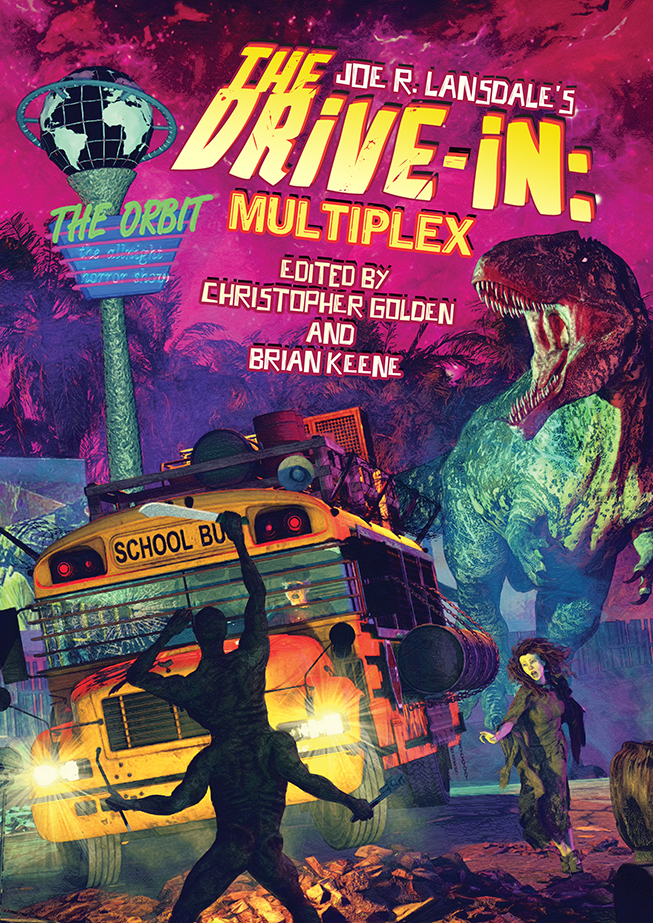
Earlier this week we dealt with the events of the first Drive-In novel. The stories today are more focused on the second and third parts of the trilogy, so if you haven't read those (let alone the first one), here be (mostly mild) spoilers.
At the end of The Drive-In, the weird shadowy goo that had trapped the denizens of the Orbit Drive-In vanishes, and the survivors stagger into a surreal world that's half prehistoric jungle and half studio backlot. After that...
Things As They Seem, What Could be and Everything Improbable by Linda D. Addison
Synopsis: Another stage setting poem--this one a bleak road trip into chaos and oblivion.
What Drive-In Movie Is It? It's really more like a trailer reel than anything, but that's a cop-out (and, most of those trailer compilations were a product of the VHS home video boom, not drive-in culture). So let's do the next best thing--it's Deadline. Both are inspired by horror literature, both feature spliced in gore-shots from other stuff, and both have a sort of downer mood.
Thoughts: It's effective at setting the mood, and it has a dark, hopeless vibe to it as opposed to the playfulness of most of the rest of the book. Not too heavy, but enough to make you pause before launching into the next section. Good stuff.
Blue Lightning by Gabino Iglesias
Synopsis: A man has escaped the Orbit and survived the perils of the strange new world he inhabits, and is building as normal a life as he can. But a figure from the past has just resurfaced. . .
What Drive-In Movie Is It? Tormented. A guy does wrong by a previous love interest and finds himself haunted by her.
Thoughts: This is one of the only stories in the book that doesn't totally do it for me. By which I mean I'm still looking forward to rereading it and laughing again at the funny parts and cringing again at the gross parts, because this is a well-written, entertaining horror story and wholly deserving of its place here. I've talked before about my "floor" and "ceiling" framework for evaluating collections (the floor is the minimum quality you can expect, and the ceiling is the maximum quality), and--in case it isn't clear from the tone of these reviews--the ceiling for this book is so high as to be, well, in orbit.
So, what don't I like about this? My problem is that the relationship between our narrator and the woman he abandoned isn't very fleshed out for the amount of moral weight he puts on it. And even that doesn't have to be a problem. For example, Mary SanGiovanni's story (see below) also has a brief relationship between the protagonist and her lover, but that story addresses and discusses the nature of their attachment.
The parts that Iglesias emphasizes in the story are the same things we've seen in the rest of the anthology. This isn't a knock on the story, because these things--the gross bits of wacky humor, and the disturbing gore, and the off-hand references to horrors beyond comprehension--are good here. But when you have an anthology, every story sort of needs to bring its own "thing" to the table. Here it, it should be the narrator's survivor's guilt, but we skip over most of the interiority and relationships that we should have in favor of a march through familiar territory. It's true that I just read all three Drive-In novels over the course of a weekend, so maybe this territory feels more familiar to me than it will for the average reader--but on the other hand, the target reader for this is probably also well-versed in the original books.
I will say this: Even if I don't think the end earns the emotional resonance it's going for, it reminds me of two great moments in two great movies: Lake Mungo and Take Shelter. And that's a helluva combo.
Orphans of the Orbit by Aaron Dries
Synopsis: Dot's mother led a group of orphaned children through the wilderness before she died. Now Dot and her fellow kids have found temporary sanctuary in an abandoned NASA facility. But they face monsters from both without and within.
What Drive-In Movie Is It? Fortress: A woman organizes a group of children into a band of wilderness survivalists.
Thoughts: This story plays it straighter than the others, and it straight. It's not somber--there's too much creativity and incongruity here for that. However, the emotions and psychological realism here stand out as more realistic. The monsters and dinosaurs are still vivid and outrageous, but they are presented more as real threats that real people have to overcome. It's a well-grounded story.
One twist in here, which doesn't come from anything in the books that I remember, but is great, is the notion that extreme emotional swings cause the Orbit survivors to mutate. At least, negative emotional swings, although there's a really mean version of this story I can imagine that would have the mutations trigger from joy. Anyway, this point reminds me of Junji Ito's work (specifically Uzumaki).
The Castle of Doctor Frankensaur by James A. Moore and Charles R. Rutledge
Synopsis: A couple of friends stumble upon the titular castle, where the titular doctor plans to perfect them (by making them human-dino hybrids of course).
What Drive-In Movie Is It? Tammy and the T-Rex. A bloody, goofy tale of guys getting their brains plonked into dino-bodies.
Thoughts: This is a fun, affectionate pastiche/spoof of Frankenstein and Island of Lost Souls, etc., which is one of those things (like noir private eyes) that's often poorly parodied. It does what so many of the exploitation pictures that inspired it rarely do, which is live up to the glorious title: There is a castle and a Doctor Frankensaur. Doctor Frankensaur is exactly what you expect him to be, and he does exactly what you hope he'd do. Along the way, we have a lot of fun.
If it seems like I'm giving this story short shrift, I'm not: A lot of what I like about it is that, like a good movie (exploitation or otherwise), it's snappy and efficient. It shows up, dives into the action, gives you precisely what you signed up for, and zips out of there.
The Drive Invasion: A Short Feature by Nancy A. Collins
Synopsis: What with the superhuman eyeball babies and the lingering cannibalistic tendencies and the lurking dinosaurs, life in Shit Town--the main settlement for Orbit survivors--is a bit rocky.
What Drive-In Movie Is It? 2020: Texas Gladiators: A Road Warrior knockoff set in post-apocalyptic Texas, with wild, brutal battles between clans of neo-barbarians.
Thoughts: Of all the stories in this book, this one feels the most like it was written by Joe hissownself (other than the one in fact written by Joe hissownself). It's wild, dirty, and has the crazy brilliant mojo of a classic Lansdale story.
It also has one simple, perfect hook: What if the same thing happened at other drive-ins? It immediately sets the imagination a-jingling and a-jangling as to what the other "themes" of drive-in survivor cults might be. In this case, we have something that results in a bit of Arkansas/Texas football rivalry, but on an apocalyptic scale.
An Ill Wind Knows Your Name by Norman Partridge
Synopsis: The mysterious benefactor of a wasteland warrior tells its story.
What Drive-In Movie Is It? Gosh, this is hard. The "right" answer is Resolution, which is very similar thematically. But we can't do that. So what's the wildest thing we can do?
Let's say a triple-feature of Spookies, Mad Foxes, and Gas-s-s-s-s. All three have things you've never seen before--just insane combinations of people, places, and things, from the fantastic to the repulsive. Gas-s-s-s-s also has some of the requisite post-apocalyptic Roger Corman element, which vibes well with a story that turns David Carradine's car from Death Race 2000 into a minor plot point.
Thoughts: Hot damn. This may have been the story Partridge was born to write. Lots of horror creators go to the well of mid-century American horror culture and the "Monster Kid" lifestyle. However, Partridge's stories have always risen above the rest. This one flies like, well, the wind.
The beginning in particular reminds me of his "Lesser Demons," one of the best horror stories of the first quarter of the 21st century. That story knocked me on my ass when I first read it, and this one did too.
What keeps this story from just being high-octane nostalgic B-movie porn is the emotional center of the story. I don't want to go too far into what exactly the narrator is, but there's something yearning and melancholy (but also hopeful) at the core. There's also an element of a cautionary tale about the need for human connection.
The Beach by Mary SanGiovanni
Synopsis: A woman fights her way through the celluloid jungle to reach the ocean at the end of the world.
What Drive-In Movie Is It? Cavegirl: A fun prehistoric romp in a weird world.
Thoughts: SanGiovanni's story encapsulates the biggest strengths and the biggest weaknesses of books 2 and 3 of The Drive-In. In terms of strengths: The prehistoric fauna/B-movie kitsch hybridity has never been better. We have swarms of vicious origami butterflies (made out of horror movie posters, of course) devouring animals with clapboard faces.
In terms of weaknesses: The problem this story has (inasmuch as there's a "problem" is the same problem the Drive-In trilogy has--eventually, there's only so much cool weird stuff you can throw on the wall, and you have to wrap things up. That isn't easy to do, and I don't think either Lansdale (in the books) or SanGiovanni (in this story) fumble the landing, but both sort of fade away.
The Wrap Party by Laird Barron
Synopsis: An aging action hero finds himself reliving his past glories when he's trapped in the Orbit.
What Drive-In Movie Is It? Targets. I thought of The Last Action Hero, but that's really not a "Drive-In" movie, even if I'm sure it's played at a couple of the holdouts since the '90s. But Targets (which Lansdale references in The Drive-In II, by the way) is the clear choice: An aging genre star shows up at a drive-in theater and ends up confronting a very real threat.
Thoughts: When it comes to theme anthologies, I'm always interested to see what authors who I wouldn't think of as natural fits for the theme do. Not that I want to pigeonhole anyone--but when you tell me "tribute anthology based on Joe Lansdale's The Drive-In," I think more Norman Partridge and David Schow than the guy who wrote The Imago Sequence. And indeed this is a distinctive story--more "literary" and elliptical and unorthodox than a lot of the rest of the book (not that the rest of this anthology is "orthodox" in terms of content--but it is in terms of being relatively straightforward).
In some ways, this reminds me of a Dennis Etchison story--wandering around the hazy brain of a Hollywood casualty, blurring reality and dreams and stumbling upon switchbacks and inversions. One of these inversions is the trick Barron plays at the end--it seems like he's setting up to have our star fighting in B-movie Valhalla forever, but there's something softer here. It's nice.
Hide/Invert: A Saga in Ten Reels by David J. Schow
Synopsis: Two people--a millennial woman searching for her slasher-addicted boyfriend, and a film-buff documentarian-find themselves within Joe R. Lansdale's cult horror novel The Drive-In.
What Drive-In Movie Is It? Cannibal Holocaust, baby! Both are convincing, well-crafted meta-fictions concerned with documentary, mockumentary, and reality, and both feature a great deal of eye-popping violence (and cannibalism).
Thoughts: I always come away from a David Schow story wanting to write. You can feel the man's passion explode from the pages. And, there are always great little touches. Here, for example, there's the way that each "reel" of the story is titled with a different anagram of "The Drive-In". It's a fun little touch. As for the story itself--there's a lot going on in terms of ideas, although one criticism I have is that this is a lot of build-up and exploring different avenues but ultimately only leaning into a few of them.
Still, the execution is great. I'm impressed by the way that Schow, who is about twice my age, satirizes millennials and their relationships and "adulting" and lapses into mediocrity and scolding. It's funny and incisive and way more than just more "haha avocado toast" stuff from Boomers. There's more to it, too--including one of the funniest and grossest dirty jokes based on a movie term ever made--and you need to get this book and read every story. Plus, it's a great excuse to "have" to read the novels.
THE END


Comments
Post a Comment